Taking over my less than scheduled blogging (sorry, life hit me in a hard way. I've got like six blogs sitting in queue that I will finish.) I wanted to a review of a book I read today. It's not a game book, it was a book on lightsaber dueling. Stunt Lightsaber Combat For Beginners: The Unofficial Guide to Dueling Like a Jedi, by Carey Martell. It is a guide to help fans of Star Wars to spar or choreograph fights using prop lightsabers.
As many of you know, lightsabers are kind of a passion of mine and sort of an amateur profession. I have been a member and instructor with the New York Jedi, the oldest lightsaber choreography group in the fandom, since February of 2009. I am currently one of the Headmasters for Terra Prime Light Armory, which seeks to use Real Life martial arts to make the lightsaber into (as close to) a real martial curriculum. I've taught lightsabers privately and with other groups, as well as written a few papers on lightsaber combat, particularly on the subject of the Seven Forms of Lightsaber Combat.
I'm saying all of this for a few reasons. I want you all to know where my biases are in regards to this. I also want you to know that I'm someone who actually takes this seriously, or as serious as you can take running around with a glow stick for the entertainment of yourself, your friends and whatever audience you cater to. Finally, I'm mentioning all of this to underscore that I am a massive nerd who has had a lot of time on his hands in his life. But most of you have read this blog, you already knew that part.
All that said, I was interested in reading Martells book. Because there is very little discussion about lightsaber dueling as a real world thing. As someone who writes about this stuff and teaches this stuff, I get enthused about new material because it helps me gain a new perspective. It's amazing how something that is make believe is really hard to develop. Perspective matters.
So, imagine how bummed I was reading the introduction for Martells book. In his introduction, he acknowledges the lightsaber groups, and then casts them off as amateurs on Youtube "squabbling" (his word) about the word "Master". So, in his first paragraph he undercuts the community who would most likely want to buy his book. But, dear readers, fear not! We are promised in this book that, Martell claims, is "so obviously missing from the market" that there will be no showboating! Not at all!
While I don't nearly have the martial prowess as Mr. Martell or even that of my peers in the lightsaber groups (one black belt and a gumbo of whatever I picked up from my better trained friends), I do have experience in one thing: promoters trying to sell themselves by undercutting the other people in the 'market'. Lightsaber dueling, either staged, sport, or spar, is a great gateway for geeks who never thought they would learn a martial art to get in to it. I know people who have gone from learning the lightsaber to being instructors in Kung Fu.
But a lot of the individuals in the community starts off alone and looking for some help about this weird hobby. So in comes a promoter that goes "Hey! Look at me! Don't look at these guys! I can help you here!" and then promptly sell their wares on you. It's a predatory kind of mentality, a mobile McDojo. It's not cool, it's not fun, and everyone who has been in the community long enough recognizes it and is zero impressed by it.
Now, that isn't to say that Martells text isn't good. As far as technique, it is a passable manual. But not for lightsabers. "I believe trying to create a functional sparring art based on a choreography which was only ever meant for the silver screen is folly," he says. This is odd because it contradicts part of the function of the book: to help choreograph fights. It also takes away one of the core aspects as to why someone would want to read a book on lightsaber dueling: the lightsaber itself.
In the book, Martell discusses the lightsaber as a prop. As simply what it is: a glorified flashlight with a polycarbonate tube shoved up the opening to create a blade with no edge. Martell's terminology openly tells you to disrgard that, and uses the technical terms for broadsword and fencing. The 'sabers' in the illustrations look more like longswords than lightsabers with crossguards added 'for hand reference' This is itself fine, in fact as far as sword manuals go its not bad. But this feels like someone wrote a decent longsword manual and added 'lightsaber' to it to make a draw. If I'm going to read a book on lightsaber dueling, I want there to be more than just lip service about the lightsaber.
If I'm going to read about lightsaber dueling in real life, I want to talk about the spirit of what is going on (because science hasn't made it practical yet) and try to find ways to make it real. I want to discuss ways of blocking and defending with a weaon with no real blade and that cuts at all angles, something that Martell actively disregards, insisting to use edge terminology of traditional swords. We're talking fictional martal arts for a fictional weapon. Let's get creative. Use real world stuff as an anchor and go for it.
Also,I want it to be stated in no uncertain terms that regardless of sport, spar, or stage combat, you're are effectively playing make believe. Lightsabers are the coolest weapons in fiction, tied in to a lush fictional culture of good guys and bad guys. Regardless of why you picked one up, you're choosing to use a lightsaber because somewhere the little kid inside you wants to play Jedi with your friends. Yes, it's geeky as hell, but it also means you have an active imagination and a degree of courage. You'll need both if you're running around public parks with a neon shinai.
And unfortunately, Carey Martells book treats lightsabers just like that: a glowing practice sword. Again, it's a passable book on basic drills, strikes, and footwork, but it does it at the cost of its main selling point. It's a book about lightsaber dueling that doesn't want to be about lightsaber dueling. If I wanted to learn about longsword and fencing, I can dig up a few manuals and study, or call up some instructor friends I met through that community Martell was quick to disparage. If any one who reads this wants to learn how to make make believe real, I suggest you check for these groups:
New York Jedi: World Famous Lightsaber Stage Combat Group, oldest in the community
Terra Prime Light Armory: Martial Artists making the unreal Real.
Saber Guild: Lightsaber Choreography Fan Group, Recognized by Disney like the 501st.
Ludosport: Lightsabe school and system for sport lightsaber combat
In the end, I give Stunt Lightsaber Combat For Beginners: The Unofficial Guide to Dueling Like a Jedi, by Carey Martell 2 out of 5 stars. 1 star for being a passable modern manual on swordplay, and another star for being one of the first published works on the subject of lightsaber combat. I assure you, it will not be the last and the bar will raise higher. It loses points for not really discussing being about lightsabers and for outright being condescending to the reader and the demographic who would actually buy this book. It isn't worth the 9.99 on kindle or the 20 bucks in print.
Showing posts with label review. Show all posts
Showing posts with label review. Show all posts
Tuesday, January 19, 2016

Wednesday, September 2, 2015
Final Fantasy VII Retrospective 'The Midgar Arc'
This is the first installment of my retrospective on Final Fantasy VII. FFVII had a very major impact on my gaming experience growing up. The concept of story and games was novel to me at the time (I was 11, sue me) and from that point on I was hooked. With the release of the game on to iOS, I felt I needed to give this game another go. This retrospective will cover things I noticed, and may not be entirely linear in its approach. This will NOT be a walkthrough, but a commentary on the game, my memories, and my hopes for the recently announced Remake and other projects. I will also, of course, discuss how this relates to us in roleplaying.
This entry will contain roughly the beginning portion of the game set in Midgar. Warning: This will contain spoilers of FFVII. If you have not played the game and don't want to know the score, please don't continue.
The game begins with everything running. Literally. You hope off of a train as the protagonist (Cloud Strife) in this dirty city surrounded by what look like industrial stacks. Your first action is to take out guards, and then advance onto one of the stacks which are actually high powered Reactors sucking natural energy into a refined energy called 'Mako'. This is killing the planet, and you're going to do something about it.
So, cool, you're here to save the world. You're doing awesome. You're....planting a bomb at the very heart of the reactor....uhm...guys....guys...? This one could go hard and to the--
Going through the game, I was shocked at the notion that I was playing the part of an eco-terrorist whose first mission was essentially a bombing run on a nuclear reactor. If you look at that video, during the Reactor going full on Praxis, several explosions to the left of it occur. Those were houses. People were sleeping.
Congrats. Twenty minutes into the game and you've killed countless people in their sleep. Well fucking done.
The concept that, yes, you're a terrorist is brought up, but its done in a very broad sense. Cloud's a generally ambivalent about the whole thing, which makes it easier for the Players to make up their own mind. Barrett and his AVALANCHE squad of doofuses are too comical to be taken seriously as a group. But we're also viewing it from Cloud's POV, he could just be viewing them as being doofuses. People around them certainly take them (and Barret 'definitely not based on Mr. T' Wallace) like a serious threat.
Again, this doesn't get looked at too in depth because the game is constantly moving and constantly setting up little pieces that are going to go off eventually. Tifa and Cloud's past together and their connection. Cloud's mysterious flashbacks/memory voices that pop in at weird times. Mentions of the great warrior, Sephiroth. The sheer callous evil that is the Shinra Corporation. And then, all of this starts to go off when Cloud falls through a Church roof and meets a flower merchant.
The plot of the game, the real plot of the game, begins when you meet Aerith (I know the US translation insists on Aeris. I'm using the universally accepted version). She is a mysterious woman who looks and has the skills of a flowery and squishy Mage, but is actually a bold tomboy. Her involvement is ultimately what makes this a simple story of freedom fighters against a Capitalistic Regime into something on a much grander scale.
During this current run on the game, I realized how fast they were going by everything. Details about the world, some of the people and characters. They were playing fast and loose. You were given just enough information to get the gist, then we'd move on to the next piece. The only time it felt like I was in what would be a now traditional RPG was during the whole Wall Market affair where I was doing errands and chores for the entire Market in a bid to sneak into some place with the most success. Other than that, the story was entirely linear.
The entire story in Midgar could have been an entire game right there. From the assault on the Reactor to the the rescue up the entire 70 floors of Shinra Headquarters in the heart of Midgar, that's set up-second act-denouement right there. The game could have been over, Cloud could resolve the sticky little triangle he suffered between Aerith and Tifa (or the girls could leave him alone, either way). But no. It's only until you reach what would be the end of the story that you're introduced to the real problem.
Now, going through the game, the dialogue and writing of the game's text has not held up well in the past two decades. Because of a lot of graphic limitations, we have to be told how bad things are instead of being shown how bad things are. But even then, we've no real context to go on. How bad is it on the outside, is there even an outside left? There's mention of a war that had gone on a few years before, but that's it. All we know is Midgar at this point.
We've no context as to where Midgar is compared to the rest of the world metaphorically speaking. We are shown more in the few minutes of the Remake announcement that cements that Midgar's environment is slowly degrading than the first act did. That's one of the reasons this game deserves a remake. So much detail was clearly put into the setting of Midgar that a full blown game could have been done by expanding the first three hours of material, but so much of the time was spent tell us about it. In a modern game, we can get the nuances of the setting and the character for granted, whereas before even though we were seeing the scenario it was so stylistically and graphically coarse that we had to fill in the gaps still.
The Midgar Arc serves the purpose of getting the player acquainted with the main characters, the antagonists, and kick starting the major problem in the setting. Because once you leave the walls of Midgar, it is an entirely different world out there.
- Later,
C
This entry will contain roughly the beginning portion of the game set in Midgar. Warning: This will contain spoilers of FFVII. If you have not played the game and don't want to know the score, please don't continue.
The game begins with everything running. Literally. You hope off of a train as the protagonist (Cloud Strife) in this dirty city surrounded by what look like industrial stacks. Your first action is to take out guards, and then advance onto one of the stacks which are actually high powered Reactors sucking natural energy into a refined energy called 'Mako'. This is killing the planet, and you're going to do something about it.
So, cool, you're here to save the world. You're doing awesome. You're....planting a bomb at the very heart of the reactor....uhm...guys....guys...? This one could go hard and to the--
Well, crap.
Going through the game, I was shocked at the notion that I was playing the part of an eco-terrorist whose first mission was essentially a bombing run on a nuclear reactor. If you look at that video, during the Reactor going full on Praxis, several explosions to the left of it occur. Those were houses. People were sleeping.
Congrats. Twenty minutes into the game and you've killed countless people in their sleep. Well fucking done.
The concept that, yes, you're a terrorist is brought up, but its done in a very broad sense. Cloud's a generally ambivalent about the whole thing, which makes it easier for the Players to make up their own mind. Barrett and his AVALANCHE squad of doofuses are too comical to be taken seriously as a group. But we're also viewing it from Cloud's POV, he could just be viewing them as being doofuses. People around them certainly take them (and Barret 'definitely not based on Mr. T' Wallace) like a serious threat.
Again, this doesn't get looked at too in depth because the game is constantly moving and constantly setting up little pieces that are going to go off eventually. Tifa and Cloud's past together and their connection. Cloud's mysterious flashbacks/memory voices that pop in at weird times. Mentions of the great warrior, Sephiroth. The sheer callous evil that is the Shinra Corporation. And then, all of this starts to go off when Cloud falls through a Church roof and meets a flower merchant.
The plot of the game, the real plot of the game, begins when you meet Aerith (I know the US translation insists on Aeris. I'm using the universally accepted version). She is a mysterious woman who looks and has the skills of a flowery and squishy Mage, but is actually a bold tomboy. Her involvement is ultimately what makes this a simple story of freedom fighters against a Capitalistic Regime into something on a much grander scale.
During this current run on the game, I realized how fast they were going by everything. Details about the world, some of the people and characters. They were playing fast and loose. You were given just enough information to get the gist, then we'd move on to the next piece. The only time it felt like I was in what would be a now traditional RPG was during the whole Wall Market affair where I was doing errands and chores for the entire Market in a bid to sneak into some place with the most success. Other than that, the story was entirely linear.
The entire story in Midgar could have been an entire game right there. From the assault on the Reactor to the the rescue up the entire 70 floors of Shinra Headquarters in the heart of Midgar, that's set up-second act-denouement right there. The game could have been over, Cloud could resolve the sticky little triangle he suffered between Aerith and Tifa (or the girls could leave him alone, either way). But no. It's only until you reach what would be the end of the story that you're introduced to the real problem.
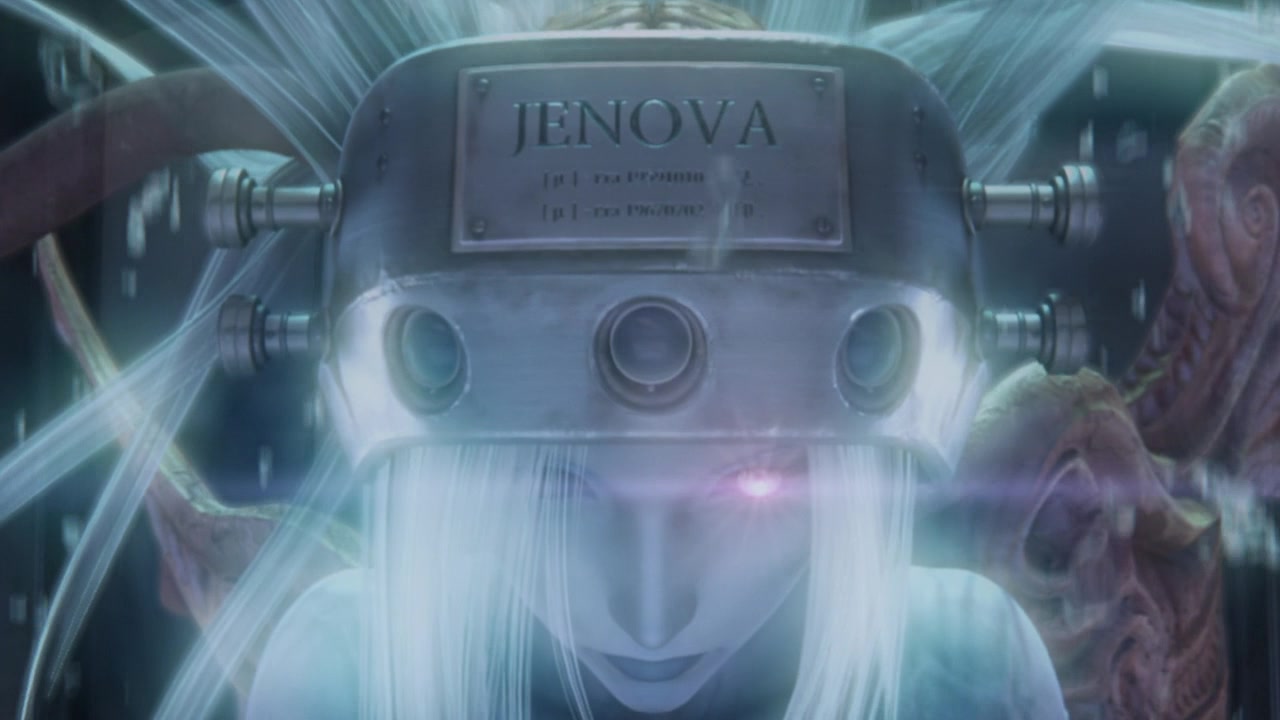 |
| This Bitch Right Here |
It's not until the creature known as 'Jenova' appears that the narrative changes. When things go pair shaped at Shinra HQ and Jenova bursts out of her/its cage, Cloud stops the show and announces that Shinra, the evil empire they and we've been dealing with for the past few hours, aren't the major threat to the planet. Keep in mind that Cloud up until now has only been doing things on a personal basis, even including saving others because they mean something to him. Cloud goes from ambivalent about the fate of the world to pointing us at the threat really fast, and with good reason we'll find out soon enough.
Now, going through the game, the dialogue and writing of the game's text has not held up well in the past two decades. Because of a lot of graphic limitations, we have to be told how bad things are instead of being shown how bad things are. But even then, we've no real context to go on. How bad is it on the outside, is there even an outside left? There's mention of a war that had gone on a few years before, but that's it. All we know is Midgar at this point.
We've no context as to where Midgar is compared to the rest of the world metaphorically speaking. We are shown more in the few minutes of the Remake announcement that cements that Midgar's environment is slowly degrading than the first act did. That's one of the reasons this game deserves a remake. So much detail was clearly put into the setting of Midgar that a full blown game could have been done by expanding the first three hours of material, but so much of the time was spent tell us about it. In a modern game, we can get the nuances of the setting and the character for granted, whereas before even though we were seeing the scenario it was so stylistically and graphically coarse that we had to fill in the gaps still.
The Midgar Arc serves the purpose of getting the player acquainted with the main characters, the antagonists, and kick starting the major problem in the setting. Because once you leave the walls of Midgar, it is an entirely different world out there.
- Later,
C
Subscribe to:
Posts (Atom)