Friday, August 29, 2014

Dear Neckbeards

To the members of the vocal male gamer contingent,

We have never met before, probably because I value things like hygiene, the open air, and the desire to have conversations in meat space except for on TeH InTERWEBS!!! Regardless of our lack of introduction, I have heard quite a deal of you, and from you, and you. You're really loud, and obnoxious. And Loudly obnoxious and obnoxiously loud.

Anyway, the reason I'm writing you this letter is to convey this message as a fellow member of the gamer community who identifies as male:

Who The Fuck Do You Think You Are?

Over the past few days, I've heard reports from the great Gamer Grapevine about members of the community and slut shaming, fat shaming, disability shaming. I've heard about bullying, insults, trolling, and death threats. Oddly enough, most of this is aimed towards female identifying members of the gaming world. I know! It's weird, right? How dare women do things in our fields, why they should just act like the crumbly rubber dolls in your bedrooms, you lonely fucks.

Listen, I'm not one to beat about the bush, especially that hedge you call a beard. Dude, those things actually go on the chin and cheeks...you're too technologically savvy to think the Amish are in chic. So as someone from the same demographic as you, allow me to say that it makes me sick to my stomach that I am part of the same demographic as you feculent toe jams. Who in the flying fuck declared you the moral police of the gaming world? I don't remember a vote being called. I don't recall putting the sanctity of our community into your Cheetos encrusted hands. Nobody sent up the white smoke and if they did they should have shared that crap. So what fucking right do you have to bash these people down!?

Now, your first reply will be this: Who the fuck am I to moralize over your decisions. To put it simply, for your simple little minds, I'm a member of the community, I'm someone who enjoys discussing games, of playing games. I enjoy going to conventions and seeing something that six years ago I wouldn't imagine: people who shared the same desires I have. Not geeks, not nerds. People. These are people who are making these games in the hopes of making a meager life entertaining their fellow gamers. These are people who are trying to improve the quality of games and the gaming community. And yes, some of them are Women. I know, I was shocked when I first found out. And you know what I did afterwards? Got the fuck over it, especially since it meant seeing something, anything, other than you. These people you are bashing for your amusement are my friends You know the drill, friends are at a premium for those of us who are socially disinclined. My friends are as close to me as family.

And some of you have been openly attacking my family. There are two women I know who have been taunted, bullied and outright had their lives threatened.. I've always seen this community, the Geek Community, the Gaming Community as a gathering of people who never really fit right in growing up. Awkward, enthused, eccentric. This community has been a haven for some of us who never really knew what it felt like to be accepted.

And you're fucking it up for the rest of us. Threats? Harassment?  When did you start thinking the jocks and preppy assholes who tormented you in school had a good model for treating others? Huh? When did calling someone a slut or fat become a way of advancing your status or argument, of being cool in your small, pointless cliques? When did you become the bullies?

I don't fucking get it. Maybe it's because I didn't grow up identifying as a geek until I was out of college when I could find outlets for my geeky self. Maybe it's because ever since I started gaming I have, from the Jedi and Ren Faire circuit, the the Mind's Eye Society; Dystopia Rising and all points around, been surrounded by bold, brilliant and beautiful women. Not girls, not chicks, Women. Oh, I know that word scares you, you feeble minded fanboy. Right now your bowels are in an uproar over how these fake gamer girls this, and how dare that girl at sunday afternoon larp didn't date you that. Maybe if you took some fiber, you'd be able to flush that irritable bowel. Or maybe you'd just be kind enough to flush yourselves.

Honestly, you would think that you'd be happy that the geek world was populated more by women, if nothing else than to dispel that we're all just a bunch of zit having virgins. But maybe that's the problem, that despite the fact that women are here and you still are a virgin that you've got this anger, and you want to lash out. You're in denial, so much so that your feet are soaked through and you are seeing the fucking Pyramids. So much so that when a woman makes an acclaimed game, you have to drag her sexlife -real or perceived- to discredit her. Does it matter if it's a game worthy of the acclaim? You're in so much denial that you would attach someone who are trying to make games accessible to people of disabilities. It's fine if you disagree with them, but at what point does shaming their disabilities -real or perceived- become the point of the argument?

Boys, you're in denial, and it's time to go into the other phases of Grief. You're douchebags. Similar to the preppy jock elitist scum we all dealt with in school, I call them Guy Dudebros, because they all look dress and act alike and in the end are as generic as you can get. You, my misogynistic meatheads,  have henceforth been dubbed Neckbeard Dudebros. You are the unwashed (in some cases, literally. Ew.) masses of the gamer community. You're that cyst on the neck of gamer life that smells of rancid offal and causes harmless yet annoying pain. You contribute nothing, you dedicate your pointless lives in tearing others down from your safe, crusty seats and congratulate yourself like you actually did something. You've done nothing. You've wasted your time and the times of others. Some of us have shit to do, some of which, whether you realize it or not, you actually benefit from.

And, I hate to tell you this, but quite a few of them that do these things aren't men...and I'll tell you a little bit more for free. Most of them...and maybe even all of them, don't frankly care whether you live or die. Maybe if you changed your attitude...or bathed. What smells like onions?

 You need to understand that we as a Communty are up and moving in a new direction. All of us. Gamers everywhere. The internet's got us all connected and people have more access to various forms of gaming and media than they've ever been able to have. We've gone beyond the dungeon crawls in your parents den. We're playing Cards Against Humanity on Google Hangout, doing Panel Discussions in New York with panelists piping in from Denmark on Skype. We've got brilliant developers coming up with game after game and getting them published and moving through Kickstarter and Patreon.

And somewhere, you're not celebrating this. Does it threaten you? Does it scare you that your notions of what it means to be a gamer are wrong?

Good.

Because quite frankly, I'm tired of having to live by your image of being a  male gamer, of being a Male Anything. I'm tired of having to witness grown men leering at teen girls at conventions and shaming them when they don't appreciate their advances. I'm tired of men shaming others as a means of discrediting their work. I don't want to live in your closed minded world. I want the barn door open and all manner of things to fly loose. If you don't want to accept that people -man, woman and all points therein and without- are out there doing things you don't like, than do the world a favor, you mouthbreathing turds. Go back to your lonely little basements and Stay There

Some of us just want to play games, you're the ones sucking the fun out of it. 

Saturday, August 23, 2014

The Quest

So I found out at the last minute (read: an hour and a half before it's premiere) that ABC was debuting a new Reality Series called "The Quest". It was shown as like The Amazing Race, but in a medieval fantasy world. Regular men and women from our side of reality are cast and put into the roles of heroes and are set on a quest to save the realm. Fast reading through some of the reviews, everyone is calling this a form of Live Action Role Play. Everyone but the showrunners.

After three episodes, here's my take on it.

A lot of the reasons why larping is such a hard hobby to describe to people outside of larping is because larps are about everyone being the performance. It's not something you can easily show to a passive audience. The only way it's worked in the past is through documentary, interspersing the action that is going on with comments from the players. Reality Shows also follow this pattern of showing you the action while having one of the folks in the scene comment on it while separated from it.

And that's how they did it here.

So, okay, the premise so far. 12 people from 'our world' were chosen by the Three Fates to become Paladins on a quest to save the fantastical kingdom of Everrealm from the oncoming Verlox. Each Paladin was given a piece of The Sunspear, an ancient weapon to fight back the dark. Only by overcoming challenges with and between each other can the one True Hero emerge to wield the Sunspear restored against Verlox. From Sanctum, the Capital of Everrealm, the 12 paladins live together and a constantly moving world world (aided by actors from around Austria, where the castle they are staying in really is).

The Fates are The Judges, The Sunspear the Reward.


Watching the first episode, I saw a lot of familiar tropes going on that many people who've ever done a fantasy role play have ever experienced. The players, still in their normal street garb, are transported across an underground river where they are met by the Fates, who guide them to their main contact. They're representing the threshold into game space, from here on in, no one is going to be in Kansas anymore. They enter and recover the fragments of the sunspear while meeting their contact, Crio. Crio leads them to the castle through a dark forest. Just as they're making their way, an Ogre appears and kills Crio's friend. Everyone bails, but as soon as the danger is over they reassess what just happened, which leads to one of the Paladins going "Okay, from here on out we NEVER Let that happen again".

They make it to Sanctum, and are then immediately put into jail by the obligatorily smarmy Vizier. It's at this point that the players get a chance to converse and talk. So you have a "You all meet in Jail" scenario, which allows the players to get to know each other and to establish themselves. Some talk about climbing the walls to escape, whilst others try to rationalize this and wait for Crio to try and spring them. After a while, they do get sprung, and it becomes clear that they will be housed in the castle and trained to defend themselves and the realm.

The format of the show is really simple. Plot happens in the first ten or fifteen minutes of the show, then comes the challenge of the day. In the first episode it was learning to fire ballistas into dummy soldier, the second involved archery and accuracy with a spear, and the third required a puzzle to get ingredients to an antidote. At the end of each challenge, the three Paladins who do the worst must complete a second challenge before the Fates. If they win, they are excused, the two who did not win risk Banishment from the world as voted on by their fellow Paladins. They then continue the plot which leads to the next episode. It's a simple plot, but there is a lot going on here.

The main thing is this: This entire premise stands out because they are interacting with a fully fleshed out world. There is a lot going on, and it's clear we're only getting the highlights. These players are immersed in the world and treat it as if it's really happening. This is aided and abetted by the NPCs that are moving about, either as citizens or as named NPCs who guide and interact with them.

What makes this whole thing special is that it's a reality show with a plot. The Reality comes from the players while everything around them is part of the show and scripted. This sometimes leads to them all huddled together as the plot happens around them, watching as the actors take part. I also have the feeling that the filming of this was done in days and not in weeks. Something about the pacing makes me think that each day is a challenge. One, because of the production value put into the show, Two, because the actors go home every day while the Paladins sleep in the castle. I would love to see this be done with a more controllable town where, if the players wished to, could go out and see people interacting and playing with one another and the players. It'd give more a sense of depth to the world.

The show reminds me of another reality show. It was called "Murder in Small Town X" it was aired in 2001, it focused on murder in a fictional town in Maine, with the players being the investigators brought in to find the killer. There was a very David Lynchian aspect to the show, with The town was entirely populated with actors whom interacted with one another around the players and with the players. There was a story and a world to explore It was at the time very ambitious, and marked with Tragedy as the winner of the show was a New York Firefighter who died during 9/11 just one week after the finale aired.

One of my major hang ups with 'Reality TV' is that it's not Reality. It's artifice, of people duking it out for fame and for money. That sets a horrible precedent. The players of the Quest aren't playing for the money, there is no money. They are playing purely for the experience, for the story. I think this enhances it for the players, as their voting of the other players removal is more emotional. There is no sense of greed, but many of them are trying to figure out a way to achieve the goal of saving the world. Many of them have said during the voting process 'They may be the One True Hero, they may not. I'm voting for them because they will help us get to that end". I think this also allows for the viewers to sit and enjoy, because there are consequences to the world around these guys. They aren't in a bubble, and their actions have consequences and there is a definite end along the way.

As a Writer, I have to help but to laugh at some of the things I see on the show. It's truly a "Fantasy Role Play Trope 101" course with generic names for locations and using common character types. The sneering Vizier, the Faithful Steward, the Unimpressed Hardass Combat Instructor, all of them are at the heart of this game and many more. The dialogue that is not exposition can almost be quoted five seconds before they say it. This does not take away from the experience, because you're watching a group of people getting to live the life of a fantasy role play protagonist.

The Quest has become a popular show, hitting many TV Watch Lists. This shows to me that people are more amenable for people to do something as outrageous as this, to follow a fantastical notion and accept that these relatively normal people are willing to do something that is as undeniably geeky and undeniably cool as living out the dream as being a hero in a fantasy novel. To quote a few of my friends, it's Larp Light. This gives me hope that people may be more accepting of the fact that we, as larpers, try to do similar. Of course, I'm a closet idealist.

Also interesting to note is that several of the players in the game are friends of my friends in the geek field. Christian is a staple of the Renfaire Circuit and Adria is a larper and Cammie herself. I'm always amazed at how small the community is, and yet how isolated we sometimes can be with one another. It will be interesting to see what the show has to offer and maybe one day I'll be able to meet some of the players and get to ask some questions.

In short, watch the Quest. It's a fun adventure, for the players, and for the audience. It gives a fairly good account of what a larp can be to those who view it from the outside, a rarity in our communiity.  For those of us who larp, this is a dream come true. And I hope that it is the first of many seasons.

Later,

C

Here's a Link to The Quest's Hulu Page: Watch Here

For the sake of Nostalgia: here's a Youtube Playlist of all of Murder in Small Town X's episodes: Watch Here

If you like this blog, and wish to make a donation, consider supporting me on my Patreon Account. It allows me to continue doing games and conventions and you'll get special prizes. You'll never be charged for reading, but any support is appreciated. Thanks

Saturday, August 16, 2014

Chronos Universal Larp System

I wrote last month about my experience playing in Rise of Tiburon, an amazing larp run by Nerdy City. The game used a version of the debuting Chronos card system as it's interface for actions in the game. I'd heard about it a year back just as it was entering it's Unfortunately, I didn't get a lot of interaction with the system. This by no means lessened the experience of the game, but I made myself a small and silent vow to make up for the deficit and buy the corebook.

My copy of Chronos came in today. It's not a large book, only 70 pages in total. There is, however, a lot of information going on here. The book is designed almost in a 'Book of Five Rings' format, with each chapter taking on one of the four classical elements which in turn feeds into the theme of their corresponding chapter. Interspersed throughout the book are four short vignettes from four different worlds, three of which appear to be focused around a specific game set on these rules: Ex-Arcana, Dreamless, and Devil Days. The fourth was an assassination set in a contemporary setting focusing on an assassination in the middle of a gaming convention. Writing what you know, huh guys?

Chronos is a card based mechanic system. You build a deck consisting of a core card, and supplemental skills, specialties and augment cards. This deck is for all intents and purposes your character sheet, but reads more or less like a Tarot spread. This makes it very easy to transition from a Tabletop -which they refer to as Narrative Play, more on that later- and larps. The Core card has the standard stats such as Health, Focus, Speed and so on, but also has several skill stats such as Brawn, Dexterity, Acumen, Resolve. There are two sets of these numbers on each card, one for action and one for defense. Challenges are done by adding up the action and adding up the defense, the one with the higher number wins the action. 

When combat is declared, the entire scene is taken into Chronos Time. All physical actions are slowed down, and all combat must be (safely) acted out in that time. Combat rounds last 30-60 seconds, and anyone who doesn't do an action in that time has not acted for that round. This means that, if everyone knows what to do and knows what cards they are using, the roleplay doesn't stop just because someone wants to fight someone else. This also means that instead of sitting there deliberately thinking of what to do, you have to respond to what is actually going on. This also means that combat is going to end soon. There is an entire conversation/rant that I'd like to give on this concept but it would detract from the review. Follow ups to come.

So having a card based role play system leads to some other interesting concepts. Along with the core deck, there will also be cards based on specific games in the line, expansions and other such things. This is actually ingenious from a business stand point, as you're selling both the games and the cards. However, it's weakness is that, for the most part, you're limited to by however many cards you have. This can be augmented by printing out pdf copies, but if someone just has the core deck printed out to him, then they reach limits. I'd recommend buying the pdf and the deck just as a backup, it's 10 dollars more, but it's a long term investment. 

The book goes into description of the Universe of Chronos, or more appropriately, Multiverse. Each game of Chronos is related by one thing: Aether. Aether is an energy source from outside Space/Time that allows for marvelous advances to occur. How it manifests depends on the world it's in, as is the way it's harvested. The general concept shows that Aether appears at some point in history, and from there time splits off into an alternate realm. So this is how Steampunk Mages may come about, how Devils can roam about in the 1950's and fight for the souls of boring squares and how the Fae can make it's deals. All of these worlds exist both separately and yet connected by the Aether. This allows for a potential overarching story, both by whatever game runner wishes to take it on and by Eschaton themselves. It gives me an idea for a story/character concept I'd love to attempt one day (guys, if you're listening...)

The other two chapters focus on more practical matters. One talks about running a Chronos game, but some sections talks about logistical concerns that any gamerunner should consider. Most fascinating though is the discussion defining what, as far as the Chronos system is concerned, is the intent of play for these games. They speak of safety, consent, and an understanding that these products that they are making and running are a form of play and play should be paramount. The goal, they say, is to make an immersive world that goes beyond rules and costumes and for the time being feels real.

In the brief time I got to hold a set of Chronos cards for Rise of Tiburon, I never once felt the need to use them. They told me of what I could do, at what at the core of my character I was. My character had a childlike glee for building fighting machines. When we were handed out our decks, I was expecting a core card that described to me something along the lines of the Innocent, with a lot of Acumen and Resolve but low on Dexterity and Brawn. I had found he was a Trickster, prone to obfuscating and keeping things secret. His cards also had a hardy bit of Brawn to them. That informed me a lot of my character and his play. I never had to use them, but they told me what he could do.

And that's the least, and in some ways the most this system can do. The Chronos system is an ambitious effort, both mechanically and as a business venture. I think the overarching universe of Chronos is something that can lead to a lot of variations, homebrewed games, and interesting crossovers that would make for fun encounters. I'm personally interested in Ex Arcana, which shouldn't be a surprise considering my love of all things Mage. It will be interesting to see where the Chronos Universe goes, both through Eschaton and the gaming community.

Later

C

If you like this blog, and wish to make a donation, consider supporting me on my Patreon Account. It allows me to continue doing games and conventions and you'll get special prizes. You'll never be charged for reading, but any support is appreciated. Thanks

Thursday, August 7, 2014

What Changed But the Name

So as some of you will be noticing, we're no longer running under the banner of "Confessions of a Wrathful Larper". There are reasons behind that, the first is simple: I'm not that Wrathful. Ranty, sure. Pedantic, oh yeah. But I'm not Wrathful. I'm not going on this site and going "Yeah? That guy? Eff that guy!"

Unless they're powergaming douchenozzles who think that LARPs and Role Play are all about proving how much of a numbers crunching badass you are. Congrats! You passed Algebra. You're the guy! NOW GO AWAY AND LEAVE ME TO MY MAKE BELIEVE.

As I was saying, I'm also changing it because I'm also aware of the fact that people are reading this (which is actually kinda terrifying) and that they too have some opinion about the profession, or moreso are making their lives around the profession (which is also just as terrifying). I'm now looking for support for my larp addiction through Patreon. In short, I'm trying to be professional in my presentation.

Alright, fine. Professional-ish...

And in the end "Confessions of a Wrathful Blogger" while snarky and sounds like the title of a book that would one day be turned into a movie starring Jay Burchel (my god...that could work...), it also doesn't draw the right kind of attention.

Some of you may be asking me why I chose the new title "Other Worlds Than These". I chose it because it's a Stephen King reference. In The Gunslinger Jake Chambers, reality hopping surrogate son of perennial badass Roland Deschain, says this at a pivotal point of the book. 'Go Then, for there are other worlds than these" and that line changes the rules quite a lot shortly thereafter. I also chose it because this is really what we're discussing in this blog, the exploration of different worlds, different mindsets, different ways of performing and creating those worlds. Even in regards to larp community itself, which is sometimes a world in and of itself, separate but linked to the real world.

So, nothing's changed. I'm still me, the site is the same, but hopefully this is a nice step forward towards improving the site and getting my voice out there.

Later,

C

PS: Also, this came in the mail today


Babies First Dice!

Saturday, July 26, 2014

Playing with FATE

After Dexcon, Shoshana gave me one task when it came to working with Phoenix Outlaw:

"Read the Fate Corebook. Read It, Learn It, Love It."

And, I did just that.

So let's get real for a second, my table top gaming experience is pretty shallow. Aside from White Wolf's New World of Darkness and three games (individual games, not campaigns) of D&D, I have no experience with tabletop games. I'm the kind of larper who looks at the system last, rather wishing to explore the world, themes and character types that can be played. I'm a Narrativist, surprise! Talking about systems and mechanics, which invariably leads to the talk about numbers, bores me to no end. When I want to hear about your character, I don't want to hear about the math, I want to hear about your character.

As someone who is desperately trying to develop his own psychotic Larp Project, the most difficult thing I've discovered is trying to build a system that works for the world. Game mechanics exist as an interface for the world we're playing in, more often than not as a means of doing in the game what we cannot physically do in reality. Some games eschew this and favor a "what you see is what you get" style of play, which I rather prefer. But in some games, especially Salon/Theater style games, you need a means of interfacing with a world that you cannot readily duplicate.

I'm of the mind that in a Tabletop game, which is all narration and discussion, you need a system to interact with the world in some way. But it's far too easy to get focused on the math, and soon you're forgetting about the Role Play and focusing about the Game, how to get the best results and how to get the best gear to get the best results. For those of you just tuning in, I do not like Min Maxing and Munchkining on general principles unless the game is literally just a smash and grab game.

So for me to get giddy about a game system means something pretty significant to me.

The Fate system is a narrative driven game system. Where most games are slavishly focused on the system of the game and emphasize rules, exceptions to the rules and the enforcement of the rules, Fate outright states it's Golden Rule as: Figure what you want to do, then consult the rules to help you do it. This is enforced further by the system's Silver Rule: Never let the rules get in the way of what makes narrative sense. These statements sort of go in the opposite direction of the way I've seen most larps be handled, where the rules are meant to keep everyone, both the players and the gamerunners, honest with one another. This makes it clear that, under no circumstances, that the story trumps the rules, and that this is a collaborative effort between the players and gamerunners.

The character creation for the game is set in primarily Four different sections: Aspects, Skills, Stunts and Stress. Aspects make up the Core of a Character, what makes them matter. These are in the form of specific phrases that are broken down in to subjects: High Concept, which denotes who they are and what they do; Their Trouble Aspect is what complicates their life. This may be seen as a negative thing, and it does stand the chance to bite the character in the ass, but there is a benefit to it; Then there are minor Aspects that can describe character relations, background events, and other things that add depth of character, often put into the context of a one sentence phrase. White Wolf does this on their sheets under Character Concept, except the Aspects are mechanically beneficial as they can potentially help aid characters in relevant actions. Importantly, most of those Aspects are developed by players building ties with one another and the ST, creating past events and ties that connect them and add bonds.

The games Skill system believes in broad strokes. Where most games rely on numbers to describe a quantitative aspects, Fate relies more on the Qualitative. Skill ratings tell how good you are in something and action pulls/rolls (if you're using cards or die) tell just how well you did a thing. The Fate System assumes that every PC is a competent individual. At the very least, PCs are mediocre and don't get bonus' to their pulls, whereas in other systems they get minuses for not paying in to a skill. They leave it mostly to chance in Fate, which is something of a point. It is blind towards equipment modifiers, someone with a gun can do just as well with a sword or even with their fists. We'll get to why in a bit. While there is a set placement of skills like Notice, Deceive, Shoot, Fight, Physique and Crafts, the system allows for customization and additions. The Dresden Files Larp has Discipline for most Supernatural actions.

Now, in most systems, certain purchases of skills means you're able to take specific actions. With Fate, that is up to Narration. In the Dresden Larp I ran, someone used Fire Magic to absorb an attacking creature made of Flame. There was nothing on his sheet specifying that he could do that, but there was a logical reason that he could, conceivably do that action. So we did the appropriate pull and, low and behold, absorbed said infernal beastie like a Ghost in a Trap.

Specific Skills come in the form of Stunts. Stunts are special actions that the players can use sparingly throughout games. Need a quick boost of a skill? Or are you capable of performing the functions of one skill with another? Do you have something that, in normal circumstances, just wouldn't be possible? Those are Stunts. They aren't always on, but they are spectacular. The Key thing to keep in mind about Stunts is that they are made entirely by the player with the Storyteller's help and approval. The books give examples of stunts, but they are only meant to give an understanding of what can be done.

Finally, we have Stress. Stress replaces the concept of health damage. First off, there are two forms of Stress: Physical and Mental. Stress alone doesn't mark how much damage you've taken, but how prone you are to take damage. When your Stress bars fill up, you go into Stress Out, which removes you from the combat completely. The only way to get back in is to take a Consequence. Consequence is where the real damage is, where Stress goes away after every combat scene. Consequences are like Aspects, in that they are small phrases, but those that denote the damage you've taken. From a gash over the eyes, induced into paranoia, to Blinded or I can't feel my legs. Gaining Consequences keeps you in the fight, but gain enough of them and your character dies.

At the Heart of this entire system are Fate Points. Fate Points are granted to the players depending on their stunt spread, more with lesser stunts and less with more. They form a sort of economy as Fate Points allow you to invoke your Aspects to aid in pulls or roleplay, to activate Stunts and to add something to the story being told. You get Fate back by accepting the ST compelling your Aspects, creating drama and story to happen to you, or by conceding a conflict. It's an entirely Meta-level economy, having relatively no basis in the game, and it's telling that the only way to gain back points is by allowing potentially bad things to happen to your character.

So the pros for the Fate System is that it focuses on and rewards a Narrative based game. A lot of my tabletop friends have made several comments though about some of it's cons. It doesn't take into account the use of weapons (the newest edition of the core book addresses this, but it also notes that focusing on better Armor/Better Weapons is the path towards Loot Hunts). This makes a little less sense when you consider that the Stress isn't actual damage, and Merely the measuring stick for what gets you the Consequences, which is the real damage, has their own negative and long lasting effects. Even then, it's still all primarily for the benefit of telling a Story over playing a game.

I think a lot of the hang ups seem based on the fact that this is a system that isn't based on the standard D&D model of thinking. It's an entirely different Operating System that relies on  This means that the concepts of class and stats are put to the back. In a fight, a social character can potentially do more damage than a combat character if they use their aspects right or if the cards are fortunate. It puts it more firmly in the hands of chance...or Fate, to be honest.

A friend of mine, who is a veteran table top player. Said that as a table top system he didn't like Fate, but after having played it in a Larp, he felt it was more appropriate. This comment reminded me of my usual rant about Role Playing Games and Live Action Role Play, and how the "G" isn't present in LARP for damn good reason. I think that people focus on the Game aspect, and assume that that means the need to win and avoidance of losing. I tend to focus more on the Role Play, and emphasize the Play. It's make believe, and the rules are there to give us the frame of the sandbox, they aren't the game entirely.

I think the Fate System agrees with this.

The comment also brings about a good point about translating systems to meet different requirements for different forms of play. The White Wolf systems are still primarily used for the Larps, pared down a bit to make some adjustments for the focus on role play...but it's still very clearly based on a tabletop. This comes out all the more when combat or a scene that requires mechanics to function need to be done. All of the roleplay and action stops and it literally becomes a table top game again. The Fate system lends itself and it's emphasis on the RP side of RPG that it works as a tool for Larps.

This is especially true since, through many of it's guides and directions, it evokes the notion that Larps are communal projects and require cross cultivation between each other. In table tops, you can rely on your sheet at the least. In a larp, where you are physically playing your character, you require the players around you to fill in the blanks in the world and with each others ties. Fate runs heavily on that concept.

Fate is, to me, a system that I as someone who looks more to character factors and background than dots and points as system I can get behind and utilize for some of my projects. This has actually gotten me interested in making a Tabletop game for friends, and possibly a theater larp. This system is NOT for everyone, but I welcome it as a system that lends itself to what I look for in a game and that can be customized to suit the needs of the game and translated into various formats of Play. If you prefer the traditional methods, then this simply isn't the system for you.

Later


If you like this blog, and wish to make a donation, consider supporting me on my Patreon Account. It allows me to continue doing games and conventions and you'll get special prizes. Thanks


Thursday, July 17, 2014

Review: Rise of Tiburon

At Dexcon, I was given the honor and pleasure to take part in one of the most anticipated Larps at Dexcon 2014. The game was Pacific Rim: The Rise of Tiburon. Based on the immensely popular 2013 Guillermo Del Toro movie, Rise of Tiburon was a high production larp created by Nerdy City. It was also one of the first games to utilize the Chronos Universal Larp System in their game play.

For those of you who haven't seen Pacific Rim, I'll give you a synopses of the world. In an alternate 2013, a giant rift in space and time opens up in the pacific ocean, unleashing a giant reptiloid-esque monster. Within the span of days, San Francisco and several other Coastal Cities are levelled before the monster is killed. Then, eventually, more came. In response, the nations of the world banded together to create weapons capable of killing what were then being called Kaiju. These weapons were called Jaegers, giant humanoid mech suits piloted by two pilots (called Rangers) who link up together and with the Jaeger to move in an effective unit. They think together, they move together, they are together. The pilots, and the machine both have to be compatible to enter what is called the Drift which links them as one.

Rise of Tiburon is set in 2023, two years before the main events of the movie, inside the Seattle Shatterbase where the Jaegars are housed. It was the original house of Mark I Jaegar codenamed Echo Thunderhead. Echo was an awesome hitter, but after years of use and the growth of larger Kaiju, he was phased out and put into disrepair. Housing a rotating cast of visiting Jaegars, the Seattle Shatterbase is the home for a colorful cast of characters that help to cancel the impending apocalypse.

When I registered, I spoke with Josh, one of the gamerunners, about what kind of character I wanted to play. In the movie, there was a scientist character who was unabashedly an admirer of the Kaiju from a scientific stand point. I asked him if it was possible to play that, but for the Jaegers. I was blessed with a childhood where every show that had the word Gundam in it, and every Power Ranger Zord to come across the screen. In short, I wanted to play someone whose love of watching Giant Robots go to town fueled his brilliance and his desire to work on the things when they became a viable reality. No sooner had I said that did Josh present to me a list of options which included exactly that.

And thus, Dr. Himura was given to me. Dr. Himura (whose first name was omitted as to allow anyone to play them. I named him Akira) had a full page dossier, including blood type, family members, and enough of a description to give me a feel for him. I'm used to larps where people come in with PCs they themselves have built, and the level of detail they put into these characters was astounding intricate. And they wrote 75 of them, each with their own agendas, history, wants and connections. In short, they could write a book simply on this game alone and still have some leftover on the cutting room floor.

I may have been drunk when that photo was taken, don't judge me

It also says something of the source material. Del Toro wrote an entire world that never showed up on the screen. Histories and Jaegers and Kaiju, the way the world reacted (which is alluded to as nearing Dystopic levels) and the rise of Kaiju Worshipping. The gamerunners clearly did their homework and used that to their advantage to build on it, extrapolating and creating a world that while there is a lot of their stuff it makes sense to the heart and soul of the core material.

Finally, game day comes, and we're given a briefing on the game, Chronos and the sections we'd be playing in. Himura was a member of J-Tech, the technicians who build and repair the Jaegars. Each character was fully fleshed out, from Chief Engineers, to neuroscience experts, to computer programmers and robotics experts (that'd be me) and munitions experts that believed More Dakka was not ever enough Dakka. Each group had their own Storyteller, ours was Miles, who played Punk-Grunge frontman Quartermaster Eli Jeong. Miles wins the award for costuming, clearly playing a native of Seattle in the "Grunge didn't die, it just got upgrades" attire. He, more than anything, sold the setting for me. Plus the band's name was Baby Seal Club, which I spent a lot of time giggling madly about (I'm a sick individual, sue me)

Speaking of the selling the setting. The production that Nerdy City put into making gamespace REAL was a masterstroke. Most of my experience was in J-Tech, a work shop with desks, a row of computers and a giant robot hand that belonged once to Echo Thunderhead...

'Sup?
There were also posters scattered throughout the spaces, some were posters straight from the movie merchandise list and some were handmade. Notices from administration, posters of some of the more fictitious Jaegers, ads for apartments in the City and flyers for Jeong's band show. J-tech was littered with paraphernalia, circuits and tools, including a diecast mini version of Dath Maul's lightsaber staff, which I immediately began twirling in my fingers, and most of the Pacific Rim Jaeger action figures, which when I saw them, I (and/or Himura) exclaimed "Ah! that's where my work station is.

This was all before game. And the moment we went in we started to work, interacting with one another, clashing ideas and reminiscing about the glory days of Echo Thunderhead. Then the sirens went off, and the screen in the room showed us look at the Seattle Skyline as Bedlam Armada, Echo's Replacement from Canada, took to the bay to meet with the incoming Tiburon, the first of the Category IV Kaiju. It was sleek, it was fast, and it dropped into the bay like a sack of titanium alloy potatoes.

With only hours before Tiburon touched down onto the coast, everyone in J-tech looked at each other, then the large giant hand in the room. A few minutes of Aikidoing Command and Echo Thunderhead was to be recommissioned for one last fight.

That was when the game really began. Repairs and rebuilds were represented by interesting minigames doled out by Miles. Computer reprogramming took the form of transferring cyphers, calibrations were done using an app that simulated the little handheld games that required you to move all the ball bearings into little divets at the same time. In order to reformat the model software, I and a team of three built a small sculpture of Echo using modelling sand that was collapsing in my hand. I enjoyed this section as it actually reflected the hardwork that we would be doing.

It was aided by the fact that certain challenges required certain proficiencies that no one person had. Himura was Great at Robotoics, and Decent in bio-tech and computers. If he was given a task that required robotics and mechanical engineering, he needed to find someone(s) to work together. This part upheld the theme to Pacific Rim, the need to work together, to compliment each other's skills. Rangers needed to be compatible to drift with the Jaeger, the crews needed to be compatible to make the Jaegers work.

After several hours of work, and a few interactions that cemented the team further, we got the job done. We were treated to watching the fight on screen, piped in live from one of the other rooms as Echo Thunderhead made it to the bay and took on Tiburon in a fight that nearly destroyed Seattle but saved millions of lives. It was interesting, watching the better part of 75 players sitting together and cheering on something that we all felt like we worked together to build.

I remember after game feeling giddy about the experience. It didn't help that each room seemed to have the Pacific Rim soundtrack playing, which is geared towards the epic and badass, and in keeping with the J-Tech Grunge, a good chunk of Black Sabbath and other bands were playing. It was a fun experience, and an immersive game all around. It kept us in J-tech busy enough that we didn't break out of character even while doing the minigames. Whoever thought of them was a genius, and regardless of who did, Miles deserves props for being an awesome ST.

My one negative is that, as a member of the J-tech Minigame squad, I did not get to use the Chronos Cards. At All. They did serve as an effective reminder of what my character could do, but there was nothing present in the environment that allowed himto do so. So as much as I'd love to do a work up of Chronos--I'll get to it eventually--it'll have to wait until my review of  FATE is done. That being said, I loved the minigames as it actually felt relevant and representative of the actions we were taking part in and was something that was actively active as opposed to turn based systems, which can take you very much out of a scene.

Other than that, Rise of Tiburon was one of those games that, as a fan of larps and a up and coming builder of larps, set the bar high for what theater larps can be. With the right amount of creativity, madness (which may be one and the same), support and funding (important, that last one) you can achieve a lot. Clearly though it can't be run by the faint of heart, and that certainly doesn't include the folks at Nerdy City. I know that many people were asking for the next run almost immediately after game, and there have been some rumors. But until then, let the guys decompress. They ran an awesome game. And not unlike the movie it was based on, we can always hope-and receive-the sequel it deserves.

Later,

Just hit Play: https://www.youtube.com/watch?v=1vU7XqToZso


If you like this blog, and wish to contribute, consider supporting me on my Patreon Account. It allows me to continue doing games and conventions and you'll get special prizes. Thanks


Wednesday, July 9, 2014

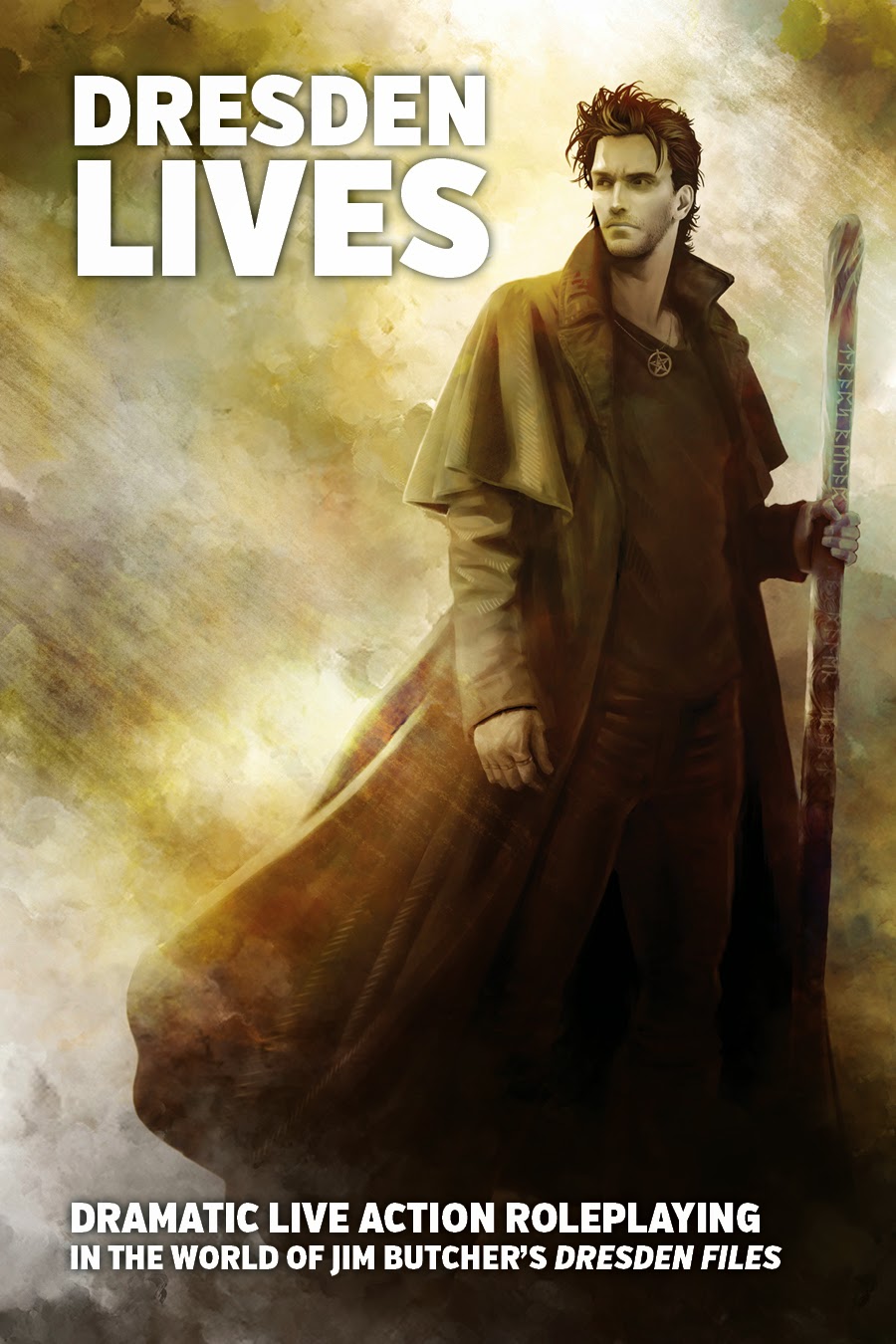
Dresden Lives

I've mentioned before that I've been honored with a position with Phoenix Outlaw Productions, a larp development company run by my friends Shoshana Kessock and Josh Harrison. While I'm more or less a general staff member, my primary focus is directed towards storytelling for Dresden Lives. Dresden Lives is the live action role play adaptation of Evil Hat's Dresden Files RPG, a developed by Phoenix Outlaw and produced by Evil Hat.

For those of you that don't know, the Dresden Files is an urban-fantasy noir series written by Jim Butcher. The series is narrated by Harry Dresden, Professional Wizard (seriously, he's in the Chicago Yellow Pages, under 'Wizard'). He finds lost items, helps the fledgling magic users as much as he can to hone their craft, and is sometimes contracted to consult with the Chicago Police Department's Special Investigations office when something that can't be easily written into a report is presented before them. Fifteen books in, and Harry has defeated countless bad guys and made allegiances and rivalries with some of the most powerful moral and supernatural forces in the modern world. There's magic, creatures of great beauty and terror, and enough sarcasm and wit to make it all very humble and self deprecating.

Dresden Lives is an expansion of Harry's World, where the supernatural forces deal in the dark places while Wizards and the few mortals in the Know get embroiled in each others schemes and plots. Depending on the gamerunners, the actions of Harry and Chicago (especially in some of the later books) may affect the storylines of those games. The players and characters get to explore the themes of the Dresden Files: Order Versus Chaos, Temptation, Predation, Faith, Hope, Love and the balance between Humanity and something Other.

I've mentioned before that I've been a long time fan of the Dresden Files series, was a main fixture of the Jim Butcher forum for a long while (under the name Uilos, in case anyone is asking), was blessed with being friends Priscilla Spencer and Richard Shealy, two of Jim's beta readers and Matthew Merbeck, who is the star and driving force for the Dresden Files Fan Films. So working with making the Dresdenverse a living thing for others to explore and play in is a major and amazing thing. So when I was given the chance to do a playtest for Phoenix Outlaw and Evil Hat, I jumped to do it.

The system for the game is based on the Fate system by Evil Hat. It is, by it's very core, a narrative experience that values role play over dice rolls. Character creation involves giving your character some flavor (it even helps in dice rolls) and by listing a very basic skills like Physique (physical strength and endurance) Shoot, Fight, Will and Discipline to name a few others. You can do magic with a straight Discipline pull, and then narrate the action with the rest of the group to respond to. This is in contrast where every magical power in the White Wolf games has clearly spelled out powers. My copy of the Fate corebook is currently in the mail, and I intend to do a full review on it. The short gist is that you and the storytellers and other players are in a game where collaboration and role play aren't just suggestions, they're kinda the central core concepts of play.

So I gathered a handful of players, got them to read the beta-test material, make some characters while I made up a setting and got a studio in the City and played a game. It's actually not that difficult to find studio space for a larp game in New York? Potentially expensive as all hell, but worth it if you have enough support from your friends and players. The game itself was set around an auction, and the various parties and factions in New York sent delegates (the players) to bid on the items. Not everyone there was what they seem, and not everything there was what it seemed either.

I've been storytelling for the MES games for nearly three years in some capacity or another. Dresden lives was hands down the most fun I've had doing it. I'll admit, I was in a room full of people I knew and trusted and who understood what the core of the game was about. But I got to do a combat scene, which I never get to do, and got to do a good one that put some people down and gave them consequences. I got to do a story that, by the end of it, had the characters eyeing each other suspiciously and having a full on conflict pop off. The general consensus was that the book needed to be more clear on a few things as to what they can do. It's an odd paradox when the choices are left open to a player. It's like the book has to spell out "no, really, you can create these on your own". 6 of the 8 were White Wolf/MES veterans. 1 was a new larper and 1 has actually played in the Dresden Larps that Dresden Lives is built on. So a lot of the issues with mechanics were just unlearning what we've spent years doing. I've had several players wanting to play more games and I've had at least one person who hadn't read the series (I wanted some people to focus on the game and not the series) tell me they were now going to read the book.

I consider that a victory.

After the playtest, I was hired on by Phoenix Outlaw to help narrate for their future Dexcon games. Dresden Lives, which started as an unofficial larp based on the RPG and is now gaining legitimacy and publication, has grown in size. We had well over 50 participants at Dexcon this year, playing everything for Wizards, to Sorcerers, to Fae and their Changeling counterparts and White Court Vampires tempting emotions on which to feed. The game was set in medias res, requiring the players and characters to figure out what the hell had happened before they got to that point, leading them to a dark hospital that carried dark secrets. In the end, I got to play a Warden, the soldiers and cops of the Wizard government, and things got very interesting very quick.

The game was played in the conference center's learning annex, where some of the rooms were transformed into the evil Hospital (which let me tell you, took a while to build it right) and the Night Market, an area of St. Marks where the magical can congregate and purchase whatever they need. There was also the Cold Room, a space in the annex where the ventilation is nil but the AC is blasting, making it a perfectly chilly space. Turn off the lights and this is the area where characters who are so inclined to talk to Spirits or Gods or Powers get the chance to talk to them.

Watching the game from a detached perspective of a narrator allowed me to watch the spirit of the game. The players were responding to the world around them, creating ties with each other and the world they were in, including an antagonist that hadn't gone off yet. This lead to a series of comments between Shoshana and I where she finally went "Wait...they haven't KILLED him yet!?" They wanted to see where it went.

Which leads to a critique of the game itself, a lot of the information the players were basing their actions on were based on the books over the game they were in. The books are told from the perspective on one man who consistently has his notions of things rocked. It's also a perspective that has experienced a lot of things out of the norm and therefore knows more about the ground game of the supernatural, most people don't speak across the aisles, making known information about groups and types of people all the more difficult. The next game, I think that there should be a general announcement going "Focus on what your character would know. Harry's casefiles aren't public knowledge and he's just one poor shmuck from Chicago whose mouth gets him into more trouble than is worth."

That's what's the problem with games based around published media. You run the risk of playing what you've read and not what your character should know. This is true of the White Wolf games, which have all of the antagonists and histories written out. One of the things that we, as storytellers and game runners have to do is note what the limits of knowledge are, or else where is the discovery in a thing? Some people have argued that that gets rid of the suspense but telling us we don't know there's something out there. Suspense isn't being revealed a bomb, suspense is knowing there's a bomb and waiting for it to go off.

But now that I've seen the games, worked through their system and seen people play it. My next question is "Well, when do I get started?" There are ideas I have forming in my head for what I'd like to do, modules and NPCs I'd like to introduce and some side plots to give some of the characters. Oh, I have ideas. Right now, my copies of the Fate corebook and the Dresden RPG are on their way, and I'll be thumbing through them to get my foundation going. I intend to do a full review of Fate once I'm done with the book, there's talks of doing something by the autumn for another game and then we'll have a few more things set up.

Until then, Later, and Dresden Lives.