This post took a while for me to write. Mostly because of life, work, and I'm working on a blog about lightsabers so I can stop crossing the streams too much.
Most of my time at GenCon was spent running around the floor of the convention doing errands and purchasing a metric crap ton of books to research and pick through and play. I only got to take part in two or three games that entire weekend. Some things happened during two of them that I need to share.
In one game, a new player made the choice to sacrifice himself for the greater good of the game. Actually, let me rephrase that. Using the powers of his faith in Heavy Metal, a modern day battlebard marched to oncoming doom, flanked on all sides by soldiers of Valhalla (and I don't mean the town in Upstate New York) while playing Immigrant Song by Led Zepplin. The player, completely cool with this, figured that as long as this was a one shot, what did they have to lose?
In another game, a player makes the decision to have his character be that guy, the one who is the firebrand, the instigator. John Adams with a bottle of mescaline in one hand a fireball in the next. He gets himself and two players in to the hands of a horrible entity. He figured that, as long as this was a one shot, what did they have to lose?
The problem with this was that these games were not One Shots. They were not meant to standalone by themselves and were in fact a part of a larger narrative that had been taking place for years both at GenCon and at other locations. In the first scenario, the outcome ended with a player making a decision that ended up effectively ending the threat to the players. However, in the second, the firebrand player realized that one of the characters he had dragged with had been in play for the better part of five years. Quite a few of the players at both games had been playing these particular characters for years.
The firebrand player immediately toned down his attitude, now realizing that there were consequences to his actions that would last beyond the day. And I think that says a lot about how people view One Shot games as opposed to Campaigns games. That level of fearlessness that comes with knowing that you may never see these players again, nor have to deal with the in game consequences that would come if the setting didn't end at the call of game, left to waver in the great 'what if' as all cliffhangers do.
That fearlessness is refreshing, but it is not without its problems. Both of these people took their characters to self destruction. Because what is a life free of consequences if you can't take it to its ultimate conclusion? You don't get to see that much in Campaigns/Chronicles because for some of us, creating and playing a character is an investment in time and resources. You need to bang together a character's background, even a skeleton, make sure you can costume as them, and maybe make some ties to other characters. Depending on the game you're playing and the person you are, you have to make that decision as to whether or not you want to play a character who has that level of fear.
Also, by playing a Chronicle game, you're essentially buying in to the larger plot. Are you prepared to throw your PC or other players' characters away on something daring? That last one is the situation that caught our firebrand friend, but I've seen it used to great affect in other situations. I helped build a character for a (now) friend who wanted to build a character who used magic that would be seen as pushing the border of grey magic. I explained that some players/NPCs might see that as a killing offense. He went for it, and it was a blast to see him play off of others. He wasn't playing it to the level of "well, if this is the only game we're all playing, what do we have to lose?" I think the difference is there.
I think there is something to say against playing campaign games at conventions like GenCon, especially if your base of operations is nowhere near the Indianapolis area as most of the game runners weren't and most people expect one offs anyway. In one game, several of us spent a good chunk of time explaining the setting to the new players, which is fine in of itself but when there isn't time to do that then people can get lost in a hurry. Campaign games will, with very few exceptions, always favor those who have played in it before with the new players needing to get over the learning curve provided by the setting and mechanics. When you're only playing a game that lasts maybe four or five hours and you never know if you'll ever play again, that can be supremely overwhelming.
I think when doing conventions or games outside of your sphere of influence, you need to bang the point home that the game you're working on is part of an overarching chronicle, and that the players decisions stand to influence what happens next. Last year at GenCon, the players in the Dresden Game unleashed what I can only refer to as a Ghost Storm that nearly consumed the continental United States. That storm was not resolved until later that February, which the STs had declared potentially chronicle ending. That's an amazing example to give to players and should be used as an example.
Another thing to consider: Find ways to plug your players in to the overarching plot. Not just the plot of the game, but the world game you're building. If the plot you're using is only going to really affect the the people you're used to playing, or requires someone from your usual pool to help, then you may want to consider tweaking things around. I've spent a lot of game sessions being sequestered to the kiddie's table while the more clued in characters/players got to do shit. We as storytellers need to make these first time/few time players feel like they spent their money wisely and not just as people holding up the set while others are around. I'm not saying to guide them by the hand, but to give them something and see what happens from it.
Monday, September 19, 2016

Sunday, June 19, 2016
Ashes of the Empire: Ilos Marr
This is a short and dirty story I wrote for the Star Wars larp I'm going to be playing in a few weeks. All information is OOC information...unless you were there.
There were 26 bones in the average humanoid's hands. The young Imperial Lieutenant who had challenged Ilos Marr--or as the officer put it, "The blind mongrel"--just learned that the hard way as every bone in his hand cracked in one deft motion. The Red Academy of Yinchorr were familiar with the screams of those who challenged their Master of Teras Kasi. Ilos felt he was providing a service to the cadets and troopers, dissuading them of the notion that somehow non-humans were inferior.
This lieutenant continued screaming, his words slowly returning to coherency. "Inhuman dog," he screamed. "Blind mutt."Ilos felt the world stir around him. There were those who shared the young man's sentiment, who had not yet been tested or who had resented being taught by a Miralukan. Men like these, Ilos found, would die in the Squall during their graduation. The Red Guard did not brook weakness. Not of body, not of heart. Ilos hated them all, but he had his pride to contend with.
There were also those he felt who would stand with him. He was given some leeway in his methods, which many of the offices resented due to the little rebellions they had to deal with on his part. They respected their instructor, some he suspected even liked him. He assumed they must forget the sash over the empty sockets where eyes would be and just think him some mad eccentric with strange powers.
They were wrong on all counts. The mad eccentric was the Emperor they served. He and his vicious guard dog, Vader. That was a fight many would love to see, including Ilos himself. He doubted he could kill either Sith--and he knew they were Sith, despite the coverup of that information--but he would make it worth their while. At least he would get an honest death out of it all. Something with honor.
But no, he had arrogant Coruscanti lieutenants to contend with. That was not a noble death. The young man continued. "Blind dog. So arrogant. When the Emperor learns you lay your hands on me, he'll have you spaced." Ilos felt the tension rise, sparks of orange and red rising in his 'vision'. The color rose, and violence rose in his heart and his gorge, and then--the world went dark around him. It was as if the Force without stopped speaking to the Force within. It was a moment's notice, and he dared not move or show he was any lesser than a Master of Teras Kasi.
The world returned, and so did the violence. Something felt different. The world around him felt cleaner.
"Attention all personnel" A voice from the intercom spoke. Ilos did not know the person, apparently they were knew. Many of the staff of the Academy saw this as a stepping stone to the Star Destroyers, perhaps even the Executor itself. There was urgency in the woman's tone, fear, and shock. What had happened?
"Attention all personnel," she said again. "We have just received word from Endor. The Death Star has been destroyed. I repeat, destroyed. As has the Executor. We believe--" There was a moment of silence, loud enough for the gasps to already begin in the room. "We believe that Emperor Palpatine and Lord Vader are dead."
The world went still, all emotions vanished. All but fear. Fear of a world where their Emperor and the Great Darth Vader were dead. Fear of a world where the Republic and the Jedi Wizards they were told to hunt would be rampant. Fear of Ilos. Even those who would have rallied for him realized that many of the things that kept their instructor in check were no longer there. The world around him held its breath.
Ilos stood straight. "I will be in my quarters." It was as much a dismissal as it was a challenge to anyone who dared to try anything. He suspected that the administrators would have everyone moving to try and maintain order. The last thing they needed was him moving around freely.
He made his way through the panic halls of the academy, finding his way to the austere quarters. He sealed the door and found his bed. He took off his veil, cloth his mother made for them. He realized in that moment that the Skywalker boy must have done it. Ashla protects fools and Jedi. He thought of Siledy, and how she was after she escaped the Empire. He thought of Xan, and prayed to Ashla to protect that girl now that her world had just changed.
He thought of his parents, of a woman who could have been his wife. He thought of how The Force ripped through him when they died at the Emepror's command. He thought of the generation of his people killed for fear of Jedi or turned to become Inquisitors. He had been robbed of his chance to kill Sheev Palpatine and Darth Vader, robbed of his chance to die proud of something for the first time since he'd been blackmailed in to serving those Sith bastards. He had been robbed, and given something he hadn't felt in a while: Hope.
And in the crumbling ashes of the empire, Ilos Marr cried tears of joy.
Monday, April 4, 2016
A Dream of Kensei
Work and life have been pretty hard the past few weeks. My days have been spent doing the 9-5 grind, and my nights have been spent doing writing for various writing projects. Add the occasional con or event, and I'm more or less putting down three jobs with only one of them paying right now.
Meanwhile, I've been dreaming of Kensei, the world martial arts tournament larp I've been working on for almost three years now. It's been hard going. I knew that making a boffer larp that was explicitly Character vs Character was going to be difficult. Most boffers are made with the characters taken on the Environment taking on the fore, with most of the CvC having to conform to those rules, oft times with major imbalances in mechanics. I didn't realize what kind of animal I was trying to tackle.
I researched a lot of material, from martial arts movies up and down the gambit (the Jean Claude Van Dam library has a lot of these) , to movies about sports tournaments, to video games and comic book arcs. I've even gotten back in to watching WWE again (As I'm writing this, I'm watching one of the best women's wrestling match ever on Wrestlemania). I wanted to understand how one could tell a story through violence, what brings people in to these situations, what are the stakes entering and what happens after the fight?
I'm still working on the details. The devil is in the mechanics. The problem is to make the game 1) fun 2) balanced and 3) as inclusive as possible. I am not a mechanics man, but the scaffolding is slowly being built. Metatopia 2015 was a big boon for me, helping me narrow down my view on the game in terms of "this is what people do and are here for."
But what's been sitting in my mind recently is how I would love to have this game played. How I want it to look when this is all said and done. I see games happening four to six times a year, no more or less. It takes place on a campground somewhere, a place that allows for sprawling views (and relatively soft ground). It also allows for events that can go on for a few days as tournaments and matches can happen during the night. An ingame radio (or hell, a podcast, technology exists here) is playing music and keeping the grounds (and people not at game) aware of the goings on.
The fights go on, the merchants sell off their wares at a part of the camp while the med techs have taken over another section to work on medical issues that happen. The reporters have dug in somewhere in to some bullpen that's a cross between William Gibson and Hunter S Thompson. The Schools have meetings in cabins at night, run promos during the day. The local underworld elements make deals and sell on the side while hiding from the authorities or worse, the press.
And all the while, the powers that be play their games. Agents and Sponsors move about, watching for ways to lobby
I don't want this to be a game just about beating each other with sticks. That's stupid. I want this to be a story about competition told through violence. What brings people to fight and compete against one another? What are the stakes? I want the roleplay to fuel the matches, and the matches to create more roleplay.
And, at the end of the 'season' of events is the big event. The blowout, where storylines can change and the stakes really matter. Right now, I have the makings of a three-five year arc. It's in my head, and I'd love to get as many people involved.
But that's when we get this off the ground. First there needs to be smaller events, to tweak the mechanics, to build interest. It's going to need players invested. It's going to need people wanting to help make the game. This game is going to require a lot of marshalls on deck, both to officiate the matches and to make sure that the rules are being fulfilled in the spirit in which they are intended.
First we need to make it real, then we get to live the dream.
Later.
Meanwhile, I've been dreaming of Kensei, the world martial arts tournament larp I've been working on for almost three years now. It's been hard going. I knew that making a boffer larp that was explicitly Character vs Character was going to be difficult. Most boffers are made with the characters taken on the Environment taking on the fore, with most of the CvC having to conform to those rules, oft times with major imbalances in mechanics. I didn't realize what kind of animal I was trying to tackle.
I researched a lot of material, from martial arts movies up and down the gambit (the Jean Claude Van Dam library has a lot of these) , to movies about sports tournaments, to video games and comic book arcs. I've even gotten back in to watching WWE again (As I'm writing this, I'm watching one of the best women's wrestling match ever on Wrestlemania). I wanted to understand how one could tell a story through violence, what brings people in to these situations, what are the stakes entering and what happens after the fight?
I'm still working on the details. The devil is in the mechanics. The problem is to make the game 1) fun 2) balanced and 3) as inclusive as possible. I am not a mechanics man, but the scaffolding is slowly being built. Metatopia 2015 was a big boon for me, helping me narrow down my view on the game in terms of "this is what people do and are here for."
But what's been sitting in my mind recently is how I would love to have this game played. How I want it to look when this is all said and done. I see games happening four to six times a year, no more or less. It takes place on a campground somewhere, a place that allows for sprawling views (and relatively soft ground). It also allows for events that can go on for a few days as tournaments and matches can happen during the night. An ingame radio (or hell, a podcast, technology exists here) is playing music and keeping the grounds (and people not at game) aware of the goings on.
The fights go on, the merchants sell off their wares at a part of the camp while the med techs have taken over another section to work on medical issues that happen. The reporters have dug in somewhere in to some bullpen that's a cross between William Gibson and Hunter S Thompson. The Schools have meetings in cabins at night, run promos during the day. The local underworld elements make deals and sell on the side while hiding from the authorities or worse, the press.
And all the while, the powers that be play their games. Agents and Sponsors move about, watching for ways to lobby
I don't want this to be a game just about beating each other with sticks. That's stupid. I want this to be a story about competition told through violence. What brings people to fight and compete against one another? What are the stakes? I want the roleplay to fuel the matches, and the matches to create more roleplay.
And, at the end of the 'season' of events is the big event. The blowout, where storylines can change and the stakes really matter. Right now, I have the makings of a three-five year arc. It's in my head, and I'd love to get as many people involved.
But that's when we get this off the ground. First there needs to be smaller events, to tweak the mechanics, to build interest. It's going to need players invested. It's going to need people wanting to help make the game. This game is going to require a lot of marshalls on deck, both to officiate the matches and to make sure that the rules are being fulfilled in the spirit in which they are intended.
First we need to make it real, then we get to live the dream.
Later.
Friday, February 26, 2016
Dreamation 2016
So I feel like I just had a rough make out session with an angry steam roller. You know what that means, I just helped run Dresden Lives at Dreamation 2016. The con drop is pretty severe this time around. I described it to people that my drawer of spoons--the metaphor for my social-emotional energy reserves--was not only empty before I got to the convention, it was on fire. Work has not been entirely gentle on me (hence the lack of blogging) and I have been catching up on five different kinds of writing and sleep. Is it possible to get con drop before walking in to the con? I'm pretty sure I got close to that answer.
It was a full docket at Dreamation. Working with Phoenix Outlaw Productions, I helped to run three games. The first of them was the Time Traveler's After Hours. Set in Death (of the Endless)'s bar, famous time travelers from fiction met, snarked, and generally fucked up time in six different directions. The first thing I heard walking in was hearing someone yell "Okay! Who made Biff Tannen the president of the United States." Things went downhill fast after that. Time broke up in to multiple fractured lines. The US was removed from existence in one, roving bands of Mongol Death Metal Hordes thrashed across the steppes in another. Taco Bell became the dominant mega power in another (thanks Deadpool), massive Brains took over the universe, discovered the internet, and effectively became the four-chan version of the Borg. The Kender and Deadpool engaged in a revolution using mind controlled dinosaurs, only to fall to civil war. Then came the Dead-Kender Accords, and all was well in that world.
Some other timelines...weren't as lucky. Neutrino Bombs claimed one timeline, The Warcraft Wars spilled blood everywhere wave after wave of ceaseless expansions. But all that was constant was that England was spared in a great time bubble protected by its four greatest guardians: John, Paul, George, and Ringo. The storytelling was pretty light here, and was mostly at the whim of the players. It was honestly the funniest experience I've ever had, and there were many times where I had to stop drawing the timeline in order to compose myself.
Afterwards was a haze of hanging out and catching up with friends I had not seen in a while, including the Outlaws. I'd forgotten how much I'd missed interactions with people, and very much loved talking and even just listening to conversations. Just that level of interaction kept me going until the wee hours. I wasn't on the hook for anything until Friday afternoon, I could afford for once to be a night person again.
Friday afternoon was the first of our Dresden games. While connected to our modern game, this was set in the 1930's. It's always amazing to see a lot of players from our normal game come in to try something a little new. Some came in as new characters, others came in as ancestors of their or other players modern characters. It was interesting to watch people who had worked with each other for years as one set of characters find a different tack. A lot of the first hour or so was just getting everyone settled in, and then we'd make the plot go.
It was a fun take, that ended in sacrifice and destruction. All in all, it set the bar for what people should have expected for the modern game on saturday night. We'll get to that in a moment.
After that was my friend Ericka's game of Agents of SHIELD, set in the era of Agent Carter. As much as I wanted to play the game, I knew my limit. I had fun, but I was burned and knew that I was on the hook for two more games back-to-back saturday. I opted out, and heard rave reviews from those I spoke to.
The rest of my night was spent in the lobby, again listening and talking to others. I actually did try to work on Kensei and some lightsaber stuff, but those books ended up never leaving my pocket. I got in to a lot of heated debates about Star Wars, and did get to go on a twenty minute diatribe about Kensei and all the things I'd like to do and things that need to be done for it. So far, people seem interested. Now, I think, it's time to build a team and make that sucker happen.
Saturday morning was the Dystopia Rising mod. All of my friends and roomates are, or were, staff at one or more of the numerous DR games that have swept the nation. To say I was the vocal minority in the "fuck, please, no, I need sleep" category is to make an understatement. I did however go down for a bit to say hello and wish people good luck. Then Michael Pucci, co-founder of Dystopia and its parent Eschaton Media, looked at me and said "You wanna take a peek?"
So I got a tour of the game space. Michael wanted to simulate a hurricane in post-apocalyptia. Now, I want to remind you all that we were in a hotel in Morristown New Jersey. But it's amazing what you can do with several industrial fans, some spray bottles, a sound and lighting system I'd kill for for New York Jedi, and a mad-genius mentality. Folks, they put a goddamned hurricane in to a hotel ballroom.
I left the game area with the very strong impression that Michael is the evil mirror universe version of Willy Wonka...and that room was the psychedelic gondola.
I took the rest of the morning to pick up a few things. Of them was the World Wide Wrestling RPG. It was my first time with a system Powered By the Apocalypse, and I think I'm going to do a review of it in the coming weeks. I'm not the only Outlaw who has it, and I'm pretty sure that one day soon we'll be having the Phoenix Cup tournament. (Pretty Please?)
The afternoon saw ExArcana. This was my first game working as a marshall for them. The rules for ExA and Chronos are both very straightforward and very different and really do rely on a lot more improvisation than what I'm used to. I also got to play my PC, Lin, who while he didn't do much got to make several decisions that may come to bite him in the ass in the near future. The main plot of the game revolved around a love story, which is something you don't inherently see a lot of in american theater larps. More on that as the plot develops.
And then, the Main Event: Dresden Files. It was the first time we had run a Dresden game for our local players since July. Since then, a lot had happen both in plot and for the game itself. So, of course, we opened up by laying it all on the line that the world could, conceivably, end. There was a moment in the storytellers meeting a week or so previously where we realized that with all of the factors running around that they world could get so borked that we would be forced to reset the game.
The game started off with a death. My NPC, Joseph Parrish, was a Warden of the White Council. He protected mortal magic users from supernatural threats and from themselves. He put one renegade wizard under his probationary gaze. However, due to a full blown war, Parrish lost sight of the Wizard who took part in a ritual that caused the deaths of hundreds of mortal combatants. The White Council doesn't like people who murder with magic. It's their first law. And, as the Wizard's keeper, Parrish was as culpable for those deaths as the Wizard was. So the game was kicked off by Warden Parrish getting executed by his colleagues.
It was rough for me, because I liked that character. There were conversations previous to the scene where Shoshana had to sit me down while trying to write a badass ending for him and went "Craig, he's gotta take a knee." And he did take a knee, and then he laid down. I found out later that several people cried when he died. I consider this a victory as a storyteller.
The game ended with the world relatively saved. But people had sacrificed a lot. People made personal sacrifices to get to the warzone, losing core truths along the way, only to find that the battle had ended (that wasn't planned). Watching the horror and dread reveal themselves on the characters (and players) faces was amazing. People left the game feeling 'mindfucked' about what had happened, but in the best possible of ways. Dresden can do that to people.
In the end, Dreamation was fun. Tiring, but fun. I'm sad I missed some fun stuff, but I'm also glad I got the free time I did. Energy is at a premium, especially coming straight from work to the convention and then right back to work less than twelve hours after it ended. The next convention, Dexcon, is going to be even more challenging as I am tentatively on the hook to be a part of four to six games. I don't intend to sleep much July 4th weekend. As always, the convention gave me a lot of new ideas to putt around here. Expect some new posts as they come. I know I haven't been on much, but I'm always thinking of new things for ya.
Later,
C
It was a full docket at Dreamation. Working with Phoenix Outlaw Productions, I helped to run three games. The first of them was the Time Traveler's After Hours. Set in Death (of the Endless)'s bar, famous time travelers from fiction met, snarked, and generally fucked up time in six different directions. The first thing I heard walking in was hearing someone yell "Okay! Who made Biff Tannen the president of the United States." Things went downhill fast after that. Time broke up in to multiple fractured lines. The US was removed from existence in one, roving bands of Mongol Death Metal Hordes thrashed across the steppes in another. Taco Bell became the dominant mega power in another (thanks Deadpool), massive Brains took over the universe, discovered the internet, and effectively became the four-chan version of the Borg. The Kender and Deadpool engaged in a revolution using mind controlled dinosaurs, only to fall to civil war. Then came the Dead-Kender Accords, and all was well in that world.
Some other timelines...weren't as lucky. Neutrino Bombs claimed one timeline, The Warcraft Wars spilled blood everywhere wave after wave of ceaseless expansions. But all that was constant was that England was spared in a great time bubble protected by its four greatest guardians: John, Paul, George, and Ringo. The storytelling was pretty light here, and was mostly at the whim of the players. It was honestly the funniest experience I've ever had, and there were many times where I had to stop drawing the timeline in order to compose myself.
Afterwards was a haze of hanging out and catching up with friends I had not seen in a while, including the Outlaws. I'd forgotten how much I'd missed interactions with people, and very much loved talking and even just listening to conversations. Just that level of interaction kept me going until the wee hours. I wasn't on the hook for anything until Friday afternoon, I could afford for once to be a night person again.
Friday afternoon was the first of our Dresden games. While connected to our modern game, this was set in the 1930's. It's always amazing to see a lot of players from our normal game come in to try something a little new. Some came in as new characters, others came in as ancestors of their or other players modern characters. It was interesting to watch people who had worked with each other for years as one set of characters find a different tack. A lot of the first hour or so was just getting everyone settled in, and then we'd make the plot go.
It was a fun take, that ended in sacrifice and destruction. All in all, it set the bar for what people should have expected for the modern game on saturday night. We'll get to that in a moment.
After that was my friend Ericka's game of Agents of SHIELD, set in the era of Agent Carter. As much as I wanted to play the game, I knew my limit. I had fun, but I was burned and knew that I was on the hook for two more games back-to-back saturday. I opted out, and heard rave reviews from those I spoke to.
The rest of my night was spent in the lobby, again listening and talking to others. I actually did try to work on Kensei and some lightsaber stuff, but those books ended up never leaving my pocket. I got in to a lot of heated debates about Star Wars, and did get to go on a twenty minute diatribe about Kensei and all the things I'd like to do and things that need to be done for it. So far, people seem interested. Now, I think, it's time to build a team and make that sucker happen.
Saturday morning was the Dystopia Rising mod. All of my friends and roomates are, or were, staff at one or more of the numerous DR games that have swept the nation. To say I was the vocal minority in the "fuck, please, no, I need sleep" category is to make an understatement. I did however go down for a bit to say hello and wish people good luck. Then Michael Pucci, co-founder of Dystopia and its parent Eschaton Media, looked at me and said "You wanna take a peek?"
So I got a tour of the game space. Michael wanted to simulate a hurricane in post-apocalyptia. Now, I want to remind you all that we were in a hotel in Morristown New Jersey. But it's amazing what you can do with several industrial fans, some spray bottles, a sound and lighting system I'd kill for for New York Jedi, and a mad-genius mentality. Folks, they put a goddamned hurricane in to a hotel ballroom.
I left the game area with the very strong impression that Michael is the evil mirror universe version of Willy Wonka...and that room was the psychedelic gondola.
I took the rest of the morning to pick up a few things. Of them was the World Wide Wrestling RPG. It was my first time with a system Powered By the Apocalypse, and I think I'm going to do a review of it in the coming weeks. I'm not the only Outlaw who has it, and I'm pretty sure that one day soon we'll be having the Phoenix Cup tournament. (Pretty Please?)
The afternoon saw ExArcana. This was my first game working as a marshall for them. The rules for ExA and Chronos are both very straightforward and very different and really do rely on a lot more improvisation than what I'm used to. I also got to play my PC, Lin, who while he didn't do much got to make several decisions that may come to bite him in the ass in the near future. The main plot of the game revolved around a love story, which is something you don't inherently see a lot of in american theater larps. More on that as the plot develops.
And then, the Main Event: Dresden Files. It was the first time we had run a Dresden game for our local players since July. Since then, a lot had happen both in plot and for the game itself. So, of course, we opened up by laying it all on the line that the world could, conceivably, end. There was a moment in the storytellers meeting a week or so previously where we realized that with all of the factors running around that they world could get so borked that we would be forced to reset the game.
The game started off with a death. My NPC, Joseph Parrish, was a Warden of the White Council. He protected mortal magic users from supernatural threats and from themselves. He put one renegade wizard under his probationary gaze. However, due to a full blown war, Parrish lost sight of the Wizard who took part in a ritual that caused the deaths of hundreds of mortal combatants. The White Council doesn't like people who murder with magic. It's their first law. And, as the Wizard's keeper, Parrish was as culpable for those deaths as the Wizard was. So the game was kicked off by Warden Parrish getting executed by his colleagues.
It was rough for me, because I liked that character. There were conversations previous to the scene where Shoshana had to sit me down while trying to write a badass ending for him and went "Craig, he's gotta take a knee." And he did take a knee, and then he laid down. I found out later that several people cried when he died. I consider this a victory as a storyteller.
The game ended with the world relatively saved. But people had sacrificed a lot. People made personal sacrifices to get to the warzone, losing core truths along the way, only to find that the battle had ended (that wasn't planned). Watching the horror and dread reveal themselves on the characters (and players) faces was amazing. People left the game feeling 'mindfucked' about what had happened, but in the best possible of ways. Dresden can do that to people.
In the end, Dreamation was fun. Tiring, but fun. I'm sad I missed some fun stuff, but I'm also glad I got the free time I did. Energy is at a premium, especially coming straight from work to the convention and then right back to work less than twelve hours after it ended. The next convention, Dexcon, is going to be even more challenging as I am tentatively on the hook to be a part of four to six games. I don't intend to sleep much July 4th weekend. As always, the convention gave me a lot of new ideas to putt around here. Expect some new posts as they come. I know I haven't been on much, but I'm always thinking of new things for ya.
Later,
C
Tuesday, January 19, 2016
Stunt Lightsaber Combat: A Review
Taking over my less than scheduled blogging (sorry, life hit me in a hard way. I've got like six blogs sitting in queue that I will finish.) I wanted to a review of a book I read today. It's not a game book, it was a book on lightsaber dueling. Stunt Lightsaber Combat For Beginners: The Unofficial Guide to Dueling Like a Jedi, by Carey Martell. It is a guide to help fans of Star Wars to spar or choreograph fights using prop lightsabers.
As many of you know, lightsabers are kind of a passion of mine and sort of an amateur profession. I have been a member and instructor with the New York Jedi, the oldest lightsaber choreography group in the fandom, since February of 2009. I am currently one of the Headmasters for Terra Prime Light Armory, which seeks to use Real Life martial arts to make the lightsaber into (as close to) a real martial curriculum. I've taught lightsabers privately and with other groups, as well as written a few papers on lightsaber combat, particularly on the subject of the Seven Forms of Lightsaber Combat.
I'm saying all of this for a few reasons. I want you all to know where my biases are in regards to this. I also want you to know that I'm someone who actually takes this seriously, or as serious as you can take running around with a glow stick for the entertainment of yourself, your friends and whatever audience you cater to. Finally, I'm mentioning all of this to underscore that I am a massive nerd who has had a lot of time on his hands in his life. But most of you have read this blog, you already knew that part.
All that said, I was interested in reading Martells book. Because there is very little discussion about lightsaber dueling as a real world thing. As someone who writes about this stuff and teaches this stuff, I get enthused about new material because it helps me gain a new perspective. It's amazing how something that is make believe is really hard to develop. Perspective matters.
So, imagine how bummed I was reading the introduction for Martells book. In his introduction, he acknowledges the lightsaber groups, and then casts them off as amateurs on Youtube "squabbling" (his word) about the word "Master". So, in his first paragraph he undercuts the community who would most likely want to buy his book. But, dear readers, fear not! We are promised in this book that, Martell claims, is "so obviously missing from the market" that there will be no showboating! Not at all!
While I don't nearly have the martial prowess as Mr. Martell or even that of my peers in the lightsaber groups (one black belt and a gumbo of whatever I picked up from my better trained friends), I do have experience in one thing: promoters trying to sell themselves by undercutting the other people in the 'market'. Lightsaber dueling, either staged, sport, or spar, is a great gateway for geeks who never thought they would learn a martial art to get in to it. I know people who have gone from learning the lightsaber to being instructors in Kung Fu.
But a lot of the individuals in the community starts off alone and looking for some help about this weird hobby. So in comes a promoter that goes "Hey! Look at me! Don't look at these guys! I can help you here!" and then promptly sell their wares on you. It's a predatory kind of mentality, a mobile McDojo. It's not cool, it's not fun, and everyone who has been in the community long enough recognizes it and is zero impressed by it.
Now, that isn't to say that Martells text isn't good. As far as technique, it is a passable manual. But not for lightsabers. "I believe trying to create a functional sparring art based on a choreography which was only ever meant for the silver screen is folly," he says. This is odd because it contradicts part of the function of the book: to help choreograph fights. It also takes away one of the core aspects as to why someone would want to read a book on lightsaber dueling: the lightsaber itself.
In the book, Martell discusses the lightsaber as a prop. As simply what it is: a glorified flashlight with a polycarbonate tube shoved up the opening to create a blade with no edge. Martell's terminology openly tells you to disrgard that, and uses the technical terms for broadsword and fencing. The 'sabers' in the illustrations look more like longswords than lightsabers with crossguards added 'for hand reference' This is itself fine, in fact as far as sword manuals go its not bad. But this feels like someone wrote a decent longsword manual and added 'lightsaber' to it to make a draw. If I'm going to read a book on lightsaber dueling, I want there to be more than just lip service about the lightsaber.
If I'm going to read about lightsaber dueling in real life, I want to talk about the spirit of what is going on (because science hasn't made it practical yet) and try to find ways to make it real. I want to discuss ways of blocking and defending with a weaon with no real blade and that cuts at all angles, something that Martell actively disregards, insisting to use edge terminology of traditional swords. We're talking fictional martal arts for a fictional weapon. Let's get creative. Use real world stuff as an anchor and go for it.
Also,I want it to be stated in no uncertain terms that regardless of sport, spar, or stage combat, you're are effectively playing make believe. Lightsabers are the coolest weapons in fiction, tied in to a lush fictional culture of good guys and bad guys. Regardless of why you picked one up, you're choosing to use a lightsaber because somewhere the little kid inside you wants to play Jedi with your friends. Yes, it's geeky as hell, but it also means you have an active imagination and a degree of courage. You'll need both if you're running around public parks with a neon shinai.
And unfortunately, Carey Martells book treats lightsabers just like that: a glowing practice sword. Again, it's a passable book on basic drills, strikes, and footwork, but it does it at the cost of its main selling point. It's a book about lightsaber dueling that doesn't want to be about lightsaber dueling. If I wanted to learn about longsword and fencing, I can dig up a few manuals and study, or call up some instructor friends I met through that community Martell was quick to disparage. If any one who reads this wants to learn how to make make believe real, I suggest you check for these groups:
New York Jedi: World Famous Lightsaber Stage Combat Group, oldest in the community
Terra Prime Light Armory: Martial Artists making the unreal Real.
Saber Guild: Lightsaber Choreography Fan Group, Recognized by Disney like the 501st.
Ludosport: Lightsabe school and system for sport lightsaber combat
In the end, I give Stunt Lightsaber Combat For Beginners: The Unofficial Guide to Dueling Like a Jedi, by Carey Martell 2 out of 5 stars. 1 star for being a passable modern manual on swordplay, and another star for being one of the first published works on the subject of lightsaber combat. I assure you, it will not be the last and the bar will raise higher. It loses points for not really discussing being about lightsabers and for outright being condescending to the reader and the demographic who would actually buy this book. It isn't worth the 9.99 on kindle or the 20 bucks in print.
As many of you know, lightsabers are kind of a passion of mine and sort of an amateur profession. I have been a member and instructor with the New York Jedi, the oldest lightsaber choreography group in the fandom, since February of 2009. I am currently one of the Headmasters for Terra Prime Light Armory, which seeks to use Real Life martial arts to make the lightsaber into (as close to) a real martial curriculum. I've taught lightsabers privately and with other groups, as well as written a few papers on lightsaber combat, particularly on the subject of the Seven Forms of Lightsaber Combat.
I'm saying all of this for a few reasons. I want you all to know where my biases are in regards to this. I also want you to know that I'm someone who actually takes this seriously, or as serious as you can take running around with a glow stick for the entertainment of yourself, your friends and whatever audience you cater to. Finally, I'm mentioning all of this to underscore that I am a massive nerd who has had a lot of time on his hands in his life. But most of you have read this blog, you already knew that part.
All that said, I was interested in reading Martells book. Because there is very little discussion about lightsaber dueling as a real world thing. As someone who writes about this stuff and teaches this stuff, I get enthused about new material because it helps me gain a new perspective. It's amazing how something that is make believe is really hard to develop. Perspective matters.
So, imagine how bummed I was reading the introduction for Martells book. In his introduction, he acknowledges the lightsaber groups, and then casts them off as amateurs on Youtube "squabbling" (his word) about the word "Master". So, in his first paragraph he undercuts the community who would most likely want to buy his book. But, dear readers, fear not! We are promised in this book that, Martell claims, is "so obviously missing from the market" that there will be no showboating! Not at all!
While I don't nearly have the martial prowess as Mr. Martell or even that of my peers in the lightsaber groups (one black belt and a gumbo of whatever I picked up from my better trained friends), I do have experience in one thing: promoters trying to sell themselves by undercutting the other people in the 'market'. Lightsaber dueling, either staged, sport, or spar, is a great gateway for geeks who never thought they would learn a martial art to get in to it. I know people who have gone from learning the lightsaber to being instructors in Kung Fu.
But a lot of the individuals in the community starts off alone and looking for some help about this weird hobby. So in comes a promoter that goes "Hey! Look at me! Don't look at these guys! I can help you here!" and then promptly sell their wares on you. It's a predatory kind of mentality, a mobile McDojo. It's not cool, it's not fun, and everyone who has been in the community long enough recognizes it and is zero impressed by it.
Now, that isn't to say that Martells text isn't good. As far as technique, it is a passable manual. But not for lightsabers. "I believe trying to create a functional sparring art based on a choreography which was only ever meant for the silver screen is folly," he says. This is odd because it contradicts part of the function of the book: to help choreograph fights. It also takes away one of the core aspects as to why someone would want to read a book on lightsaber dueling: the lightsaber itself.
In the book, Martell discusses the lightsaber as a prop. As simply what it is: a glorified flashlight with a polycarbonate tube shoved up the opening to create a blade with no edge. Martell's terminology openly tells you to disrgard that, and uses the technical terms for broadsword and fencing. The 'sabers' in the illustrations look more like longswords than lightsabers with crossguards added 'for hand reference' This is itself fine, in fact as far as sword manuals go its not bad. But this feels like someone wrote a decent longsword manual and added 'lightsaber' to it to make a draw. If I'm going to read a book on lightsaber dueling, I want there to be more than just lip service about the lightsaber.
If I'm going to read about lightsaber dueling in real life, I want to talk about the spirit of what is going on (because science hasn't made it practical yet) and try to find ways to make it real. I want to discuss ways of blocking and defending with a weaon with no real blade and that cuts at all angles, something that Martell actively disregards, insisting to use edge terminology of traditional swords. We're talking fictional martal arts for a fictional weapon. Let's get creative. Use real world stuff as an anchor and go for it.
Also,I want it to be stated in no uncertain terms that regardless of sport, spar, or stage combat, you're are effectively playing make believe. Lightsabers are the coolest weapons in fiction, tied in to a lush fictional culture of good guys and bad guys. Regardless of why you picked one up, you're choosing to use a lightsaber because somewhere the little kid inside you wants to play Jedi with your friends. Yes, it's geeky as hell, but it also means you have an active imagination and a degree of courage. You'll need both if you're running around public parks with a neon shinai.
And unfortunately, Carey Martells book treats lightsabers just like that: a glowing practice sword. Again, it's a passable book on basic drills, strikes, and footwork, but it does it at the cost of its main selling point. It's a book about lightsaber dueling that doesn't want to be about lightsaber dueling. If I wanted to learn about longsword and fencing, I can dig up a few manuals and study, or call up some instructor friends I met through that community Martell was quick to disparage. If any one who reads this wants to learn how to make make believe real, I suggest you check for these groups:
New York Jedi: World Famous Lightsaber Stage Combat Group, oldest in the community
Terra Prime Light Armory: Martial Artists making the unreal Real.
Saber Guild: Lightsaber Choreography Fan Group, Recognized by Disney like the 501st.
Ludosport: Lightsabe school and system for sport lightsaber combat
In the end, I give Stunt Lightsaber Combat For Beginners: The Unofficial Guide to Dueling Like a Jedi, by Carey Martell 2 out of 5 stars. 1 star for being a passable modern manual on swordplay, and another star for being one of the first published works on the subject of lightsaber combat. I assure you, it will not be the last and the bar will raise higher. It loses points for not really discussing being about lightsabers and for outright being condescending to the reader and the demographic who would actually buy this book. It isn't worth the 9.99 on kindle or the 20 bucks in print.
Wednesday, November 11, 2015
Reflections on Metatopia 2015
It's currently wednesday as I write this, that may change when I post this. First of all, for the four or five of you that actually do read this blog, I'm sorry for the gap between posts. Work, Freelance Work, Imaginary Work and a dozen other things took over my life. There's also the fact that I'm not larping once a month any more, which lessens how often I get to think about things and ruminate. However, now that Metatopia is done, I have a few things to share with you all.
Going to Metatopia as a game designer for the first time was nerve racking to me. It was kind of funny to sit down and notice the panic attacks the days before. They were regularly scheduled and pretty much anticipated. I was presenting a game for the first time, I was going to be on a panel for the first time in a very long time.
The first thing I recall from the convention was that this was really the first time that I was constantly doing stuff. Whether it was running around to prep for my panel, or for my game, or just talking to people, I was doing something. Normally at these conventions I have a few hours between events to rest and recharge. I didn't have that here, and I was surprised to find that I didn't need it as much either. Getting home, however, proved to be a lesson in paying up on my sleep debt. In many ways, I still am.
As I said, I went to present Kensei as a game concept in a Focus Group. It wasn't a playtest, but a stress test for information to make sure the game was feasible. As a Character vs Character boffer larp tournament, I wanted to make sure that the game was feasible and that there was a market for it beyond stick jockeys thwacking each other (that's going to happen, I just want to know other people were interested in it as well). I had two slots. The friday morning slot went about as well as one thought: it was pretty much empty for the most part. It was friday morning, people either hadn't shown up or were still zonked out from travelling or networking the night before. I spent that time writing notes of my own, figuring at the very least I could get some work done on Kensei
Someone did eventually show up, game designer and academic Evan Torner. We talked casually for a while, mostly on Living Games Conference (where we had met a year and a half previously) as well as his recent run of Just a Little Loving, a Nordic Larp set in the early 80's and focused on the LGBT community during the initial outbreak of AIDS. We also spoke of the upcoming run of New World Magischola, a Nordic Larp inspired by the Wizarding World of Harry Potter and run in a similar fashion as College of Wizardry.
We did, eventually, talk Kensei. The setting was fascinating. The setting was, of course, all I had. He gave me advice on how to start fashioning the mechanics to create the game I wanted: focus on what the theme was. If the theme of the game was the community forming around these fights, then the mechanics should be centered around that. That sounds so simple, but it was something that I wasn't grokking on at all while building this game.
To sum up the experience, here is an excerpt from a conversation I had with my friend Josh:
Josh: So how'd it go?
Josh: So how'd it go?
Craig: Not bad, only one person came in to look at the game.
Josh: Who was it?
Craig: Evan Torner
Craig: Evan Torner
Josh: So five people came in to look at Kensei, good.
The next day was more populated, with players I know from Dresden and from DR. One person was a practitioner of Aikido, Kenjutsu and Iaido. I made noises like a seal because I could sit and talk a different kind of shop with them for a few moments. In the end, they gave me a really great place to move on to next in developing the game, and solved a major problem I had fixed myself in to. That being said, people want to play this game, and I think I can make it.
This game is going to get made.
I also took part in my first panel at a Double Exposure convention. It focused on the use of Sanity Points in games to denote mental health. That's a whole conversation in and of itself and will get a blog post of its own in the near future. The panel consisted of myself, Elsa Henry, Kelly Osborne, and Will Hindmarch. It shows how new I am to gaming and the gaming community when I recognized Will's name but couldn't put my finger on where I knew it. Then Elsa announced his contributions to White Wolf, especially in the writing of Mage the Awakening.
For those of you keeping score at home, why yes, I'm a fan of Mage the Awakening. It is my favorite setting in the New World of Darkness line, even if it did drive me to drink after a while. So to have Will next to me was kind of a high note. I thanked him for Mage after the panel. The panel itself went beautifully, we could have been there for another hour and only just gotten in it. Signs point to a repeat next year.
The rest of the panel was playtesting. I tested a freeform larp called Waiting for Slenderman....which is as horrible and amazing as it sounds. The game was designed and run by KN Granger and Jacqueline Bryk. An hour or so in the dark while your character, who either thinks Slenderman is a hoax, real, or is neutral to the situation, is waiting for a promised appearance by Tall, Pale and Faceless itself.
Another playtest was Nicholas Malinowski's tabletop game, Nementia. A steampunk world based on Welsh mythology? How could I resist. The game shows a lot of promise, and its a setting that I would dearly love to run a campaign for at some point.
I also got to test Evil hat's Dresden Files Cooperative Card Game. The system was interesting, and since I suck out loud I'm going to leave it to Evil Hat to describe it better. What I can say is that the deck of character cards you get to play are amazingly in keeping with the characters themselves. I got to play a game where Harry Dresden, Michael Carpenter, Karrin Murphy, The Alphas, and Susan Rodriguez got to take on the Storm Front casefile. I got to play Michael, and it felt like I was able to play to the character's strengths and got to have a flavor for 'this is how he does it'. I'm looking forward to seeing how it develops.
The rest of the convention was talking and chatting with people. I hit that point in my experience at these conventions where I don't always feel like a wallflower. Most of us talked about past experiences in previous clubs, while other conversations were about incoming video games. I also got in to a very passionate conversation about Star Wars (surprise!) and other conventions in the area.
I also hit that point in my stay there were people assume I've been at these conventions or in the community a lot longer than I have. This is a talent I have no control over, and it happens every time. People assume I've always been in the community. Moments of mentioning someone I haven't met yet as if I would remember them. I know this isn't uncommon, but this happens a lot to me every time I go in to a new community. If I knew how to magically insert myself in to people's timelines, I'd have a much easier time.
The convention was not without its problems. Not to me, specifically, but there were stories of behavior that really didn't seem to jive with the attitude I had attributed to Metatopia. There were a few incidences of playtesters telling designers that there games should use an established system instead of building a new one. There was one incidence of a playtester telling a designer that they should go to the traderoom and buy all of the Fate games to fix their understanding of Fate Core.
The prize winner, for me, was when one designer was told by one person that her game had no relevancy. To be clear, this game was a bout a sensitive topic in the world (I won't go in to specifics as I do not have permission to disclose). The dissenting tester went so far as to invoke his status as a "Southern Gentleman" to emphasize how little he felt her game was in any way relevant. The quotes are there because this was what was told to me. This is hearsay, but due to the climate of gaming
Let's get a few things straight, one: this was bullshit on the highest level. If it isn't your cup of tea to play, don't play it. No one person or group has the right to say what should and should not be presented. Secondly...a "Southern Gentleman"? Seriously? At what point was that actually relevant to the discussion? What criteria were they using? Normally, if a man is invoking his right as a Gentleman, then someone was entitled to challenging him to a duel for the insult he laid on this designer. It is such an absurd thing to say, made all the worse by the gatekeeping he was perpetrating at a convention where people are invited to develop and try new things.
I think that was a point that some of the convention goers missed when they registered. Metatopia is, as far as I could tell, a place where designers and testers get together and try out new shit. Its not Metatopia where you drive the new hot car on to stage, its where you have the blue print for a hot new car and want others to look it over and test drive a model. It's an experimental jam session, where designers can tweak their games with the help of their peers and also to hang out and network with one another. It's informal, and there was a small rush of people who seemed to want to make it something a lot more.
But talking to the convention runners, that doesn't seem the case. Avie and Vinny are amazing people. That they were able to sit down with convention goers and talk over their input on the con--both things to fix and things to keep--is something refreshing. I never get the sense that we're just convention goers to them, they know us to one degree or another and are open to reception.
But talking to the convention runners, that doesn't seem the case. Avie and Vinny are amazing people. That they were able to sit down with convention goers and talk over their input on the con--both things to fix and things to keep--is something refreshing. I never get the sense that we're just convention goers to them, they know us to one degree or another and are open to reception.
Metatopia was a great experience for me, and one which I already look forward to having again next november. Hopefully by then, Kensei will be ready for testing. Goal set, see you there.
Later,
C
Later,
C
Wednesday, September 2, 2015
Final Fantasy VII Retrospective 'The Midgar Arc'
This is the first installment of my retrospective on Final Fantasy VII. FFVII had a very major impact on my gaming experience growing up. The concept of story and games was novel to me at the time (I was 11, sue me) and from that point on I was hooked. With the release of the game on to iOS, I felt I needed to give this game another go. This retrospective will cover things I noticed, and may not be entirely linear in its approach. This will NOT be a walkthrough, but a commentary on the game, my memories, and my hopes for the recently announced Remake and other projects. I will also, of course, discuss how this relates to us in roleplaying.
This entry will contain roughly the beginning portion of the game set in Midgar. Warning: This will contain spoilers of FFVII. If you have not played the game and don't want to know the score, please don't continue.
The game begins with everything running. Literally. You hope off of a train as the protagonist (Cloud Strife) in this dirty city surrounded by what look like industrial stacks. Your first action is to take out guards, and then advance onto one of the stacks which are actually high powered Reactors sucking natural energy into a refined energy called 'Mako'. This is killing the planet, and you're going to do something about it.
So, cool, you're here to save the world. You're doing awesome. You're....planting a bomb at the very heart of the reactor....uhm...guys....guys...? This one could go hard and to the--
Going through the game, I was shocked at the notion that I was playing the part of an eco-terrorist whose first mission was essentially a bombing run on a nuclear reactor. If you look at that video, during the Reactor going full on Praxis, several explosions to the left of it occur. Those were houses. People were sleeping.
Congrats. Twenty minutes into the game and you've killed countless people in their sleep. Well fucking done.
The concept that, yes, you're a terrorist is brought up, but its done in a very broad sense. Cloud's a generally ambivalent about the whole thing, which makes it easier for the Players to make up their own mind. Barrett and his AVALANCHE squad of doofuses are too comical to be taken seriously as a group. But we're also viewing it from Cloud's POV, he could just be viewing them as being doofuses. People around them certainly take them (and Barret 'definitely not based on Mr. T' Wallace) like a serious threat.
Again, this doesn't get looked at too in depth because the game is constantly moving and constantly setting up little pieces that are going to go off eventually. Tifa and Cloud's past together and their connection. Cloud's mysterious flashbacks/memory voices that pop in at weird times. Mentions of the great warrior, Sephiroth. The sheer callous evil that is the Shinra Corporation. And then, all of this starts to go off when Cloud falls through a Church roof and meets a flower merchant.
The plot of the game, the real plot of the game, begins when you meet Aerith (I know the US translation insists on Aeris. I'm using the universally accepted version). She is a mysterious woman who looks and has the skills of a flowery and squishy Mage, but is actually a bold tomboy. Her involvement is ultimately what makes this a simple story of freedom fighters against a Capitalistic Regime into something on a much grander scale.
During this current run on the game, I realized how fast they were going by everything. Details about the world, some of the people and characters. They were playing fast and loose. You were given just enough information to get the gist, then we'd move on to the next piece. The only time it felt like I was in what would be a now traditional RPG was during the whole Wall Market affair where I was doing errands and chores for the entire Market in a bid to sneak into some place with the most success. Other than that, the story was entirely linear.
The entire story in Midgar could have been an entire game right there. From the assault on the Reactor to the the rescue up the entire 70 floors of Shinra Headquarters in the heart of Midgar, that's set up-second act-denouement right there. The game could have been over, Cloud could resolve the sticky little triangle he suffered between Aerith and Tifa (or the girls could leave him alone, either way). But no. It's only until you reach what would be the end of the story that you're introduced to the real problem.
Now, going through the game, the dialogue and writing of the game's text has not held up well in the past two decades. Because of a lot of graphic limitations, we have to be told how bad things are instead of being shown how bad things are. But even then, we've no real context to go on. How bad is it on the outside, is there even an outside left? There's mention of a war that had gone on a few years before, but that's it. All we know is Midgar at this point.
We've no context as to where Midgar is compared to the rest of the world metaphorically speaking. We are shown more in the few minutes of the Remake announcement that cements that Midgar's environment is slowly degrading than the first act did. That's one of the reasons this game deserves a remake. So much detail was clearly put into the setting of Midgar that a full blown game could have been done by expanding the first three hours of material, but so much of the time was spent tell us about it. In a modern game, we can get the nuances of the setting and the character for granted, whereas before even though we were seeing the scenario it was so stylistically and graphically coarse that we had to fill in the gaps still.
The Midgar Arc serves the purpose of getting the player acquainted with the main characters, the antagonists, and kick starting the major problem in the setting. Because once you leave the walls of Midgar, it is an entirely different world out there.
- Later,
C
This entry will contain roughly the beginning portion of the game set in Midgar. Warning: This will contain spoilers of FFVII. If you have not played the game and don't want to know the score, please don't continue.
The game begins with everything running. Literally. You hope off of a train as the protagonist (Cloud Strife) in this dirty city surrounded by what look like industrial stacks. Your first action is to take out guards, and then advance onto one of the stacks which are actually high powered Reactors sucking natural energy into a refined energy called 'Mako'. This is killing the planet, and you're going to do something about it.
So, cool, you're here to save the world. You're doing awesome. You're....planting a bomb at the very heart of the reactor....uhm...guys....guys...? This one could go hard and to the--
Well, crap.
Going through the game, I was shocked at the notion that I was playing the part of an eco-terrorist whose first mission was essentially a bombing run on a nuclear reactor. If you look at that video, during the Reactor going full on Praxis, several explosions to the left of it occur. Those were houses. People were sleeping.
Congrats. Twenty minutes into the game and you've killed countless people in their sleep. Well fucking done.
The concept that, yes, you're a terrorist is brought up, but its done in a very broad sense. Cloud's a generally ambivalent about the whole thing, which makes it easier for the Players to make up their own mind. Barrett and his AVALANCHE squad of doofuses are too comical to be taken seriously as a group. But we're also viewing it from Cloud's POV, he could just be viewing them as being doofuses. People around them certainly take them (and Barret 'definitely not based on Mr. T' Wallace) like a serious threat.
Again, this doesn't get looked at too in depth because the game is constantly moving and constantly setting up little pieces that are going to go off eventually. Tifa and Cloud's past together and their connection. Cloud's mysterious flashbacks/memory voices that pop in at weird times. Mentions of the great warrior, Sephiroth. The sheer callous evil that is the Shinra Corporation. And then, all of this starts to go off when Cloud falls through a Church roof and meets a flower merchant.
The plot of the game, the real plot of the game, begins when you meet Aerith (I know the US translation insists on Aeris. I'm using the universally accepted version). She is a mysterious woman who looks and has the skills of a flowery and squishy Mage, but is actually a bold tomboy. Her involvement is ultimately what makes this a simple story of freedom fighters against a Capitalistic Regime into something on a much grander scale.
During this current run on the game, I realized how fast they were going by everything. Details about the world, some of the people and characters. They were playing fast and loose. You were given just enough information to get the gist, then we'd move on to the next piece. The only time it felt like I was in what would be a now traditional RPG was during the whole Wall Market affair where I was doing errands and chores for the entire Market in a bid to sneak into some place with the most success. Other than that, the story was entirely linear.
The entire story in Midgar could have been an entire game right there. From the assault on the Reactor to the the rescue up the entire 70 floors of Shinra Headquarters in the heart of Midgar, that's set up-second act-denouement right there. The game could have been over, Cloud could resolve the sticky little triangle he suffered between Aerith and Tifa (or the girls could leave him alone, either way). But no. It's only until you reach what would be the end of the story that you're introduced to the real problem.
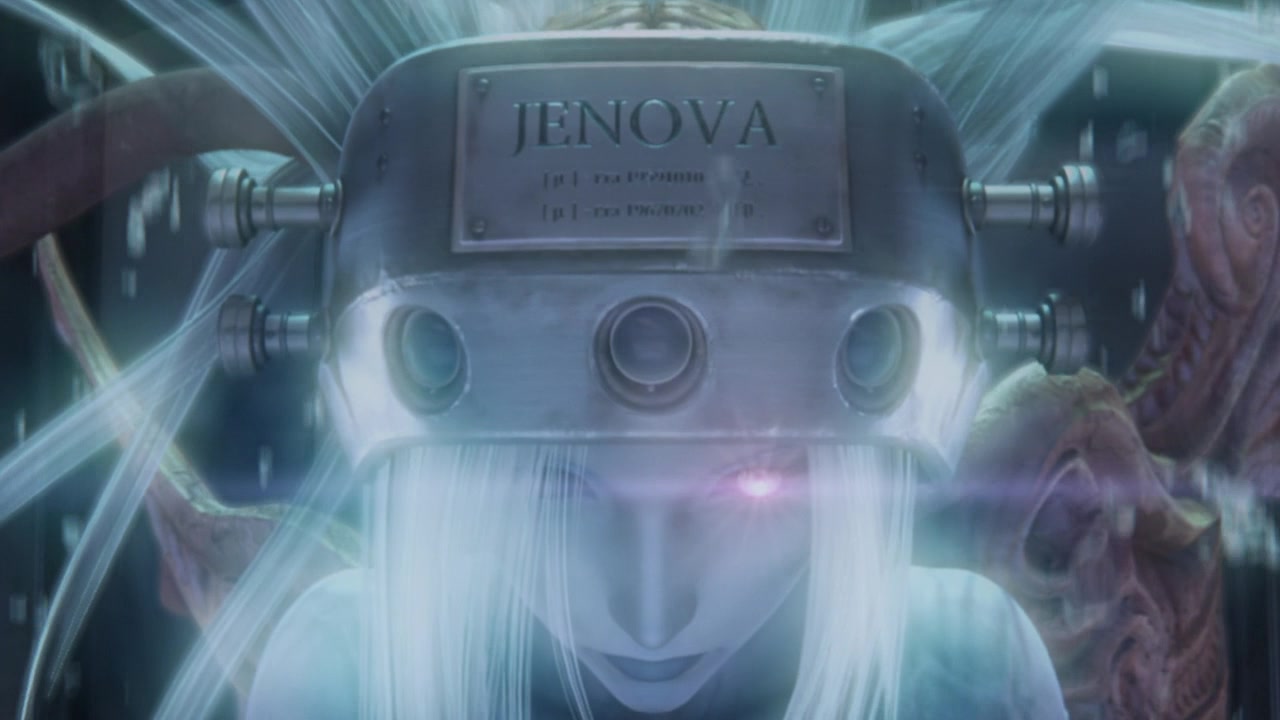 |
| This Bitch Right Here |
It's not until the creature known as 'Jenova' appears that the narrative changes. When things go pair shaped at Shinra HQ and Jenova bursts out of her/its cage, Cloud stops the show and announces that Shinra, the evil empire they and we've been dealing with for the past few hours, aren't the major threat to the planet. Keep in mind that Cloud up until now has only been doing things on a personal basis, even including saving others because they mean something to him. Cloud goes from ambivalent about the fate of the world to pointing us at the threat really fast, and with good reason we'll find out soon enough.
Now, going through the game, the dialogue and writing of the game's text has not held up well in the past two decades. Because of a lot of graphic limitations, we have to be told how bad things are instead of being shown how bad things are. But even then, we've no real context to go on. How bad is it on the outside, is there even an outside left? There's mention of a war that had gone on a few years before, but that's it. All we know is Midgar at this point.
We've no context as to where Midgar is compared to the rest of the world metaphorically speaking. We are shown more in the few minutes of the Remake announcement that cements that Midgar's environment is slowly degrading than the first act did. That's one of the reasons this game deserves a remake. So much detail was clearly put into the setting of Midgar that a full blown game could have been done by expanding the first three hours of material, but so much of the time was spent tell us about it. In a modern game, we can get the nuances of the setting and the character for granted, whereas before even though we were seeing the scenario it was so stylistically and graphically coarse that we had to fill in the gaps still.
The Midgar Arc serves the purpose of getting the player acquainted with the main characters, the antagonists, and kick starting the major problem in the setting. Because once you leave the walls of Midgar, it is an entirely different world out there.
- Later,
C
Subscribe to:
Posts (Atom)